
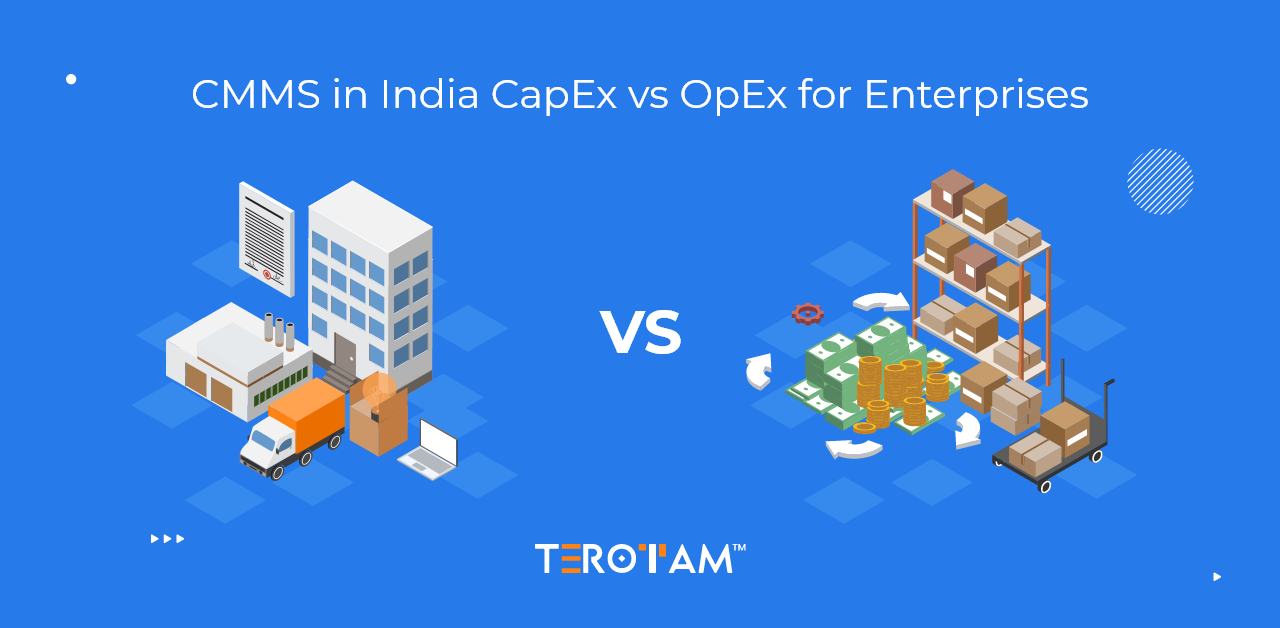
Indian enterprises implementing Computerized Maintenance Management Systems face a critical financial strategy decision: should they invest in large upfront capital expenditure for on-premise solutions or opt for ongoing operational expenditure through cloud-based subscription models? This choice impacts cash flow, IT infrastructure requirements, scalability, and total cost of ownership over 3 to 5 year periods—critical considerations for manufacturing, power generation, and industrial companies across India.
The CapEx versus OpEx decision extends beyond simple cost comparison. Capital expenditure approaches require significant upfront investment but offer long-term ownership and complete data control. Operational expenditure models preserve working capital through predictable subscription payments but create ongoing dependency on vendors. Each approach carries distinct advantages and disadvantages that align differently with enterprise financial strategies, growth trajectories, and risk tolerance levels.
This article breaks down both approaches with specific guidance for Indian enterprise decision-makers evaluating CMMS implementation strategies.
Understanding CapEx vs OpEx in the CMMS Context
The fundamental distinction between CapEx and OpEx approaches lies in how costs are recognized and managed within enterprise financial structures. Capital expenditure treats CMMS implementation as a long-term asset investment with upfront costs depreciated over useful life. Operational expenditure treats CMMS as an ongoing service expense with predictable recurring payments. This financial classification impacts budget approval processes, cash flow management, and long-term cost planning for Indian enterprises.
Capital Expenditure (CapEx) Approach: On-Premise CMMS Ownership
Capital expenditure involves a large upfront investment in software licenses, server infrastructure, and implementation services—treated as capital assets on balance sheets and depreciated over their useful lives. This approach represents traditional enterprise software procurement, where organizations purchase perpetual licenses and host systems within their own infrastructure.
Typical CapEx CMMS implementation includes perpetual software licenses, dedicated server hardware, database licenses, network infrastructure upgrades, and extensive customization services. Indian enterprises choosing this approach typically seek long-term ownership, complete data control within their firewall, and predictable costs after the initial investment period. However, they face significant upfront budget requirements that can impact working capital available for core operations and growth initiatives.
The CapEx model appeals to enterprises with established IT departments, existing infrastructure capacity, and a preference for complete system ownership. These organizations value freedom of customization, data sovereignty, and independence from vendor subscription dependencies. However, they must commit substantial capital upfront and accept responsibility for ongoing maintenance, upgrades, and infrastructure management.
Operational Expenditure (OpEx) Approach: Cloud-Based CMMS Subscription
Operational expenditure involves ongoing subscription payments treated as operational expenses—eliminating large upfront investment while providing predictable monthly or annual costs with minimal infrastructure requirements. This approach represents the modern SaaS (Software as a Service) model, where vendors host and maintain systems while customers access functionality through web browsers and mobile applications.
Typical OpEx CMMS implementation includes subscription fees, minimal customization costs, and pay-per-user or pay-per-asset pricing models with automatic updates included at no additional cost. Indian enterprises choosing this approach typically seek faster implementation timelines, lower initial investment, automatic upgrades, and scalability without infrastructure management responsibilities. However, they face ongoing recurring costs and dependency on vendor performance and availability.
The OpEx model appeals to enterprises prioritizing cash flow preservation, faster time-to-value, and operational flexibility. These organizations value automatic updates, built-in disaster recovery, and the ability to scale usage up or down based on business needs. However, they must accept limited customization options, data residing on vendor servers, and ongoing subscription dependencies that may impact long-term budgeting.
CapEx Approach: Deep Analysis for Indian Enterprises
Capital expenditure implementation requires careful financial planning and executive approval due to significant upfront investment requirements. Indian enterprises must evaluate not only initial costs but also long-term ownership implications, including depreciation schedules, maintenance contracts, infrastructure upkeep, and technology refresh cycles. This comprehensive analysis ensures the CapEx approach aligns with organizational financial strategy and delivers expected return on investment over the asset lifecycle.
Initial Investment Breakdown
CapEx CMMS implementation requires a comprehensive upfront investment across software licensing, hardware procurement, infrastructure setup, and professional services. Indian enterprises must budget ₹30 to 60 lakhs for mid-size implementations, depending on user count, asset inventory, and customization requirements. This significant capital commitment impacts cash flow and requires executive approval processes that can delay implementation timelines.
- Perpetual software licenses typically range from ₹15 to 25 lakhs for mid-size enterprise deployments
- Server hardware and storage infrastructure require ₹5 to 10 lakhs, depending on scale and redundancy requirements
- Database licenses and middleware costs add ₹3 to 7 lakhs to the initial investment
- Network infrastructure upgrades for on-premise hosting typically cost ₹2 to 5 lakhs
- Implementation and customization services range from ₹8 to 15 lakhs based on complexity
- Training and change management programs require ₹2 to 4 lakhs for organization-wide adoption
- Contingency budget of 15 to 20 percent accounts for unexpected requirements and scope changes
Long-Term Financial Implications
CapEx spreads costs over the asset lifecycle through depreciation while requiring ongoing maintenance and support expenses. Indian enterprises typically depreciate CMMS infrastructure over 5 to 7 years, reducing annual accounting impact while maintaining predictable operational costs. However, annual maintenance contracts, infrastructure upkeep, and periodic hardware refreshes create ongoing expenses that must be budgeted alongside initial investment.
- Depreciation over a 5 to 7-year useful life reduces annual accounting impact and provides tax benefits
- Annual maintenance contracts typically cost 18 to 22 percent of the license cost for updates and technical support
- Infrastructure maintenance and dedicated IT staff create ongoing operational costs of ₹3 to 6 lakhs annually
- Major version upgrades may require additional investment every 3 to 5 years for new features and compatibility
- Hardware refresh cycles every 4 to 6 years, add ₹5 to 10 lakhs to long-term ownership costs
- Opportunity cost of capital tied up in upfront investment impacts other growth initiatives and working capital
Advantages of the CapEx Approach
- Complete data ownership and control within the enterprise infrastructure and firewall
- No dependency on vendor for system availability, performance, or uptime
- Predictable long-term costs after the initial investment period with minimal recurring expenses
- Customization freedom without SaaS platform limitations or multi-tenant constraints
- Potential tax benefits through depreciation allowances and capital asset treatment
- Suitable for enterprises with existing IT infrastructure and dedicated technical staff
Disadvantages of the CapEx Approach
- Large upfront capital requirement significantly impacts cash flow and working capital availability
- A longer implementation timeline of 6 to 12 months delays the return on investment realization
- Requires dedicated IT staff for ongoing maintenance, support, and infrastructure management
- Technology obsolescence risk as hardware ages and software requires periodic upgrades
- Limited scalability without additional infrastructure investment and customization effort
- Higher risk if implementation fails or business requirements change significantly
OpEx Approach: Deep Analysis for Indian Enterprises
Operational expenditure models have transformed CMMS accessibility for Indian enterprises by eliminating traditional barriers to entry. The subscription-based approach converts what was once a major capital decision into an operational budget item, enabling faster implementation and greater financial flexibility. Organizations can now access enterprise-grade maintenance management capabilities without significant upfront investment or dedicated IT infrastructure.
Recurring Cost Structure
OpEx CMMS implementation converts high upfront costs into manageable monthly expenses through predictable subscription models. Indian enterprises typically pay ₹800 to 1,500 per user per month or ₹200 to 500 per asset per month, depending on vendor pricing structure and feature requirements. This approach preserves working capital for core operations while providing access to enterprise-grade functionality without infrastructure investment.
- Monthly subscription fees per user typically range from ₹800 to 1,500 for standard functionality
- Per-asset pricing models cost ₹200 to 500 per asset per month for equipment-heavy operations
- Implementation and onboarding fees are one-time costs ranging from ₹3 to 8 lakhs
- Customization and integration costs vary based on complexity but typically stay under ₹5 lakhs
- Training and support are usually included in a subscription or available as affordable add-ons
- No infrastructure costs—vendor manages all hosting, maintenance, and security requirements
Financial Flexibility Benefits
OpEx preserves capital for core business operations while providing predictable budgeting and easier scalability. Indian enterprises benefit from consistent monthly expenses that simplify financial planning and forecasting. The ability to add users or assets without infrastructure investment supports business growth without capital approval processes. Automatic upgrades and updates keep systems current without additional investment or disruption.
- Preserves working capital for production expansion, equipment purchases, and growth initiatives
- Predictable monthly expenses simplify budget planning and financial forecasting processes
- Easy scalability—add users or assets without infrastructure investment or capital approval
- Automatic upgrades and updates, included at no additional cost, keep the system current
- Lower risk—can discontinue subscription if solution doesn’t meet needs or requirements change
- Faster implementation of 4 to 8 weeks accelerates the return on investment realization
Advantages of the OpEx Approach
- Minimal upfront investment preserves cash flow for core operations and strategic initiatives
- Faster implementation timeline delivers measurable value within weeks rather than months
- No infrastructure management or dedicated IT staff requirements for system maintenance
- Automatic updates and upgrades keep the system current without additional investment or disruption
- Built-in disaster recovery, data backup, and security measures are included in the subscription
- Easy scalability to accommodate business growth or seasonal operational fluctuations
Disadvantages of the OpEx Approach
- Ongoing recurring costs may exceed CapEx total over long-term periods of 5+ years
- Limited customization options due to multi-tenant architecture and platform constraints
- Data resides on vendor servers—requires trust in vendor security practices and availability
- Subscription price increases over time may impact long-term budgeting and cost predictability
- Dependency on the vendor for system performance, uptime, and the feature development roadmap
- Potential integration limitations with existing on-premise systems and legacy applications
Decision Framework: Which Approach is Right for Your Indian Enterprise?
Selecting between CapEx and OpEx approaches requires evaluating multiple organizational factors beyond simple cost comparison. Enterprise size, financial position, IT capabilities, growth trajectory, and strategic objectives all influence which model delivers optimal value. This decision framework provides clear criteria to guide Indian enterprises toward an approach that aligns with their specific circumstances and long-term goals.
Choose the CapEx Approach If:
- Enterprise has ₹30+ lakhs available for upfront CMMS investment without impacting core operations
- Existing IT infrastructure and dedicated technical staff can support on-premise hosting and maintenance
- Data security requirements mandate on-premise hosting within the enterprise firewall and control
- Long-term ownership of 7+ years is preferred over ongoing subscription dependencies
- Extensive customization requirements exceed SaaS platform capabilities and flexibility
- Enterprise operates in a highly regulated industry requiring complete data control and audit trails
Choose the OpEx Approach If:
- Cash flow preservation is critical for ongoing operations, equipment purchases, and growth initiatives
- An implementation timeline of under 8 weeks is required to address urgent maintenance gaps or compliance needs
- IT resources are limited or focused on core business systems rather than infrastructure management
- Business growth trajectory is uncertain—need flexibility to scale usage up or down quickly
- Access to the latest features, automatic updates, and continuous improvements is valued over customization depth
- Total cost predictability and budget simplicity are primary financial objectives for decision-makers
Hybrid Approach: Combining CapEx and OpEx Strategies
Some Indian enterprises find that neither pure CapEx nor pure OpEx approaches fully meet their requirements. Hybrid strategies offer flexibility by combining elements of both models to balance immediate operational needs with long-term strategic objectives. This approach allows organizations to leverage the strengths of each model while mitigating their respective limitations.
Phased Implementation Strategy
Some Indian enterprises adopt hybrid approaches that combine CapEx and OpEx strategies to balance immediate needs with long-term objectives. This flexible approach allows organizations to validate CMMS value through quick OpEx implementation while planning for eventual CapEx ownership, or implementing critical modules on-premise while leveraging cloud capabilities for mobile access and advanced analytics.
- Begin with an OpEx subscription to validate CMMS value and build user adoption before a major capital commitment
- Transition to CapEx after 2 to 3 years, once return on investment is proven and requirements are stabilized
- Implement core maintenance modules on-premise while using cloud services for mobile technician access
- Host sensitive operational data on-premise while leveraging cloud analytics and reporting capabilities
- Use OpEx subscription for new facilities or acquisitions while maintaining CapEx for established operations
Implementation Timeline and ROI Considerations
Implementation timelines and return on investment periods differ significantly between CapEx and OpEx approaches, impacting when enterprises realize value from their CMMS investment. Understanding these timelines helps organizations plan resource allocation, set realistic expectations, and measure success against defined milestones. Faster implementation typically accelerates ROI realization but may limit customization depth.
CapEx Implementation Timeline
CapEx CMMS implementations typically require 9 to 12 months from vendor selection to full operational deployment. The extended timeline includes infrastructure procurement, software installation, extensive customization, comprehensive testing, and organization-wide training. Return on investment is typically realized in Year 2 to 3 after full user adoption and process optimization.
- Months 1 to 2: Vendor selection, contract negotiation, and project planning
- Months 3 to 4: Infrastructure procurement, server setup, and network configuration
- Months 5 to 8: Software installation, customization, integration testing, and data migration
- Months 9 to 12: User training, pilot deployment, full rollout, and optimization
- Return on investment is typically realized in Years 2 to 3 after complete adoption
OpEx Implementation Timeline
OpEx CMMS implementations typically complete within 6 to 8 weeks from subscription activation to full operational deployment. The accelerated timeline includes configuration, basic customization, user training, and data import. Return on investment is typically realized within 6 to 9 months due to faster implementation and immediate productivity improvements.
- Weeks 1 to 2: Vendor selection, subscription activation, and initial configuration
- Weeks 3 to 4: Basic customization, integration setup, and user account creation
- Weeks 5 to 6: User training, data import, and pilot testing with select teams
- Weeks 7 to 8: Full rollout, optimization, and ongoing support transition
- Return on investment is typically realized within 6 to 9 months of implementation
Conclusion
The CapEx versus OpEx decision for CMMS implementation depends on your enterprise’s financial strategy, IT capabilities, growth trajectory, and risk tolerance. Indian enterprises with strong cash positions, existing IT infrastructure, and a preference for long-term ownership may benefit from CapEx approaches. Those prioritizing cash flow preservation, faster implementation timelines, and operational flexibility typically achieve better results with OpEx subscription models.
Modern CMMS platforms offer both deployment options with similar core functionality. The choice is primarily financial and strategic rather than technical. Evaluate your enterprise’s specific requirements, budget constraints, growth plans, and long-term objectives before making this critical decision. Consider conducting a detailed cost-benefit analysis over 5-year periods to understand the total cost of ownership for each approach.
Ready to evaluate which financial strategy fits your enterprise’s CMMS implementation needs? Contact financial strategy specialists at contact@terotam.com for a detailed cost-benefit analysis and customized recommendation tailored to your specific situation and business objectives.