
Enterprise CMMS platforms serve hundreds of users across maintenance, operations, finance, and management—each accessing sensitive equipment histories, vendor contracts, compliance documentation, and operational data. Without proper access controls, technicians might accidentally modify critical asset configurations, finance personnel could view confidential maintenance strategies, or vendors might access competitor facility information. These security gaps create data integrity risks, compliance violations, and operational inefficiencies that undermine the entire maintenance management system.
Uncontrolled access leads to unauthorized modifications that compromise reliability analysis and regulatory compliance. A technician changing preventive maintenance frequencies without approval, a vendor deleting work order completion records, or a manager altering inventory costs without finance oversight—all create data inconsistencies that cascade through reporting, budgeting, and decision-making processes. In regulated industries like pharmaceuticals, power generation, and aerospace, these integrity breaches can trigger audit failures, compliance penalties, and operational shutdowns.
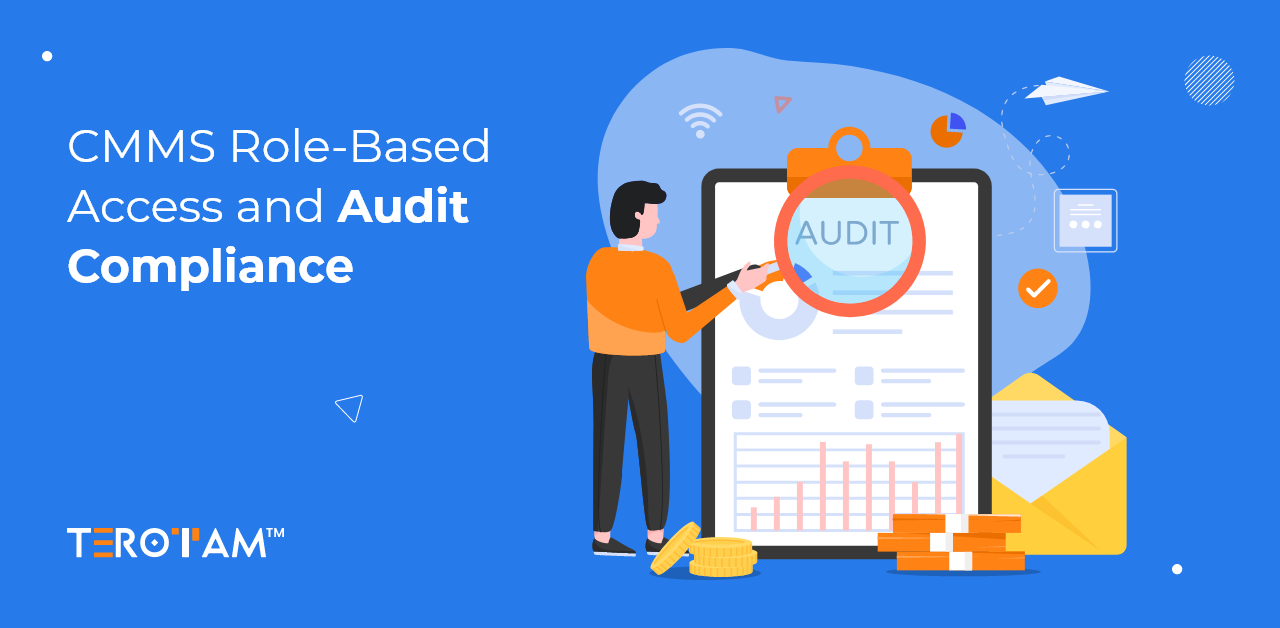
Role-based access controls and comprehensive audit trails secure CMMS data while enabling appropriate visibility across organizational levels. These security mechanisms ensure users can perform their job functions without accessing or modifying data beyond their authority. The result is a trustworthy maintenance platform where data integrity, operational accountability, and regulatory compliance coexist seamlessly.
Understanding Role-Based Access Control in CMMS
Role-based access control (RBAC) assigns permissions based on job functions rather than individual users, creating consistent security policies across large organizations with frequent staff changes. When a new technician joins the team, they receive the predefined “Technician” role with appropriate access to work orders, asset histories, and parts inventory—without manual configuration for each permission. When employees change roles or leave the organization, administrators simply modify or revoke role assignments rather than rebuilding individual access profiles from scratch.
This approach eliminates security gaps from inconsistent permission assignments and reduces administrative overhead for system maintenance. Organizations with multiple facilities across different regions apply identical role templates consistently, ensuring security standards remain uniform regardless of location or local IT support capabilities. RBAC also supports compliance requirements by providing clear documentation of who has access to what data and why—critical during regulatory audits and internal security reviews.
Critical CMMS User Roles and Their Required Permissions
Granular role definition ensures each user has precisely the access needed to perform their job functions without compromising data security or operational integrity. Organizations should map roles to actual job responsibilities rather than creating overly broad access categories that violate the principle of least privilege.
System Administrator – Full configuration access, user management, system settings, security controls, database backups, and integration management across all facilities and modules.
Maintenance Manager – Work order approval authority, technician assignment capabilities, inventory management oversight, preventive maintenance scheduling, and comprehensive reporting access for team performance metrics.
Reliability Engineer – Preventive maintenance schedule configuration, failure mode analysis tools, asset criticality settings, root cause analysis workflows, and reliability-centered maintenance strategy development.
Technician – Work order execution access, asset history viewing for troubleshooting, parts requisition submission, time logging capabilities, and mobile documentation tools for field work completion.
Inventory Manager – Spare parts catalog management, purchase order creation and approval, stock level configuration, vendor management for procurement, and inventory valuation reporting.
Finance User – Cost reporting dashboards, budget tracking tools, vendor payment approval workflows, labor cost analysis, and financial compliance documentation—without operational system modification rights.
Executive Viewer – Dashboard analytics for KPI monitoring, compliance status reporting, OEE tracking, maintenance budget utilization, and strategic decision support—view-only access with no data modification capabilities.
Vendor/Contractor – Limited work order access for assigned tasks, time entry and completion documentation, parts usage logging for billing, and communication tools for coordination—no system configuration or data export rights.
Why Audit Controls Are Non-Negotiable in Enterprise CMMS
Regulatory compliance requirements mandate complete audit trails for maintenance activities across industries. ISO 9001, ISO 14001, OSHA regulations, and industry-specific standards require organizations to demonstrate who performed what maintenance, when it occurred, and what parts or procedures were used. Audit trails provide this evidence during compliance inspections, proving maintenance activities were performed according to approved procedures and documented appropriately. Without immutable audit logs, organizations cannot verify compliance during regulatory audits or customer quality system reviews.
Operational accountability depends on tracing who changed what, when, and why during incident investigations. When equipment fails unexpectedly, investigation teams need to reconstruct maintenance history—including any modifications to preventive schedules, asset configurations, or work order procedures. Audit trails show exactly which user modified maintenance frequencies, when those changes occurred, and what the previous settings were. This forensic capability prevents blame-shifting, identifies process breakdowns, and enables corrective actions that prevent repeat failures.
Data integrity protection requires audit controls to prevent unauthorized modifications or deletions that compromise reliability analysis. Maintenance strategies depend on accurate historical data to identify failure patterns, optimize preventive schedules, and justify capital investments. If users can modify or delete work order records without detection, reliability engineers cannot trust the data driving their decisions. Immutable audit logs ensure every change is recorded and traceable, maintaining data credibility for strategic planning and continuous improvement initiatives.
Essential Audit Trail Capabilities Every Enterprise CMMS Must Have
Comprehensive audit tracking captures every user interaction with the CMMS platform, creating an immutable record of system activity that supports compliance, security, and operational accountability. These capabilities ensure organizations can reconstruct any maintenance event, user action, or system change with complete accuracy and transparency.
- Timestamp every user login, logout, and session duration to track system access patterns and detect unauthorized usage attempts
- Record all data modifications with before/after values and user identification to enable forensic reconstruction of changes
- Track work order status changes with timestamps and responsible personnel for complete workflow accountability
- Log asset record modifications including criticality changes, location updates, and configuration adjustments
- Capture inventory transactions with quantities, costs, approval chains, and vendor information for financial audit trails
- Monitor report generation and data exports to prevent unauthorized data extraction or competitive intelligence leaks
- Record system configuration changes with mandatory change justification requirements and approval workflows
- Maintain immutable audit logs that cannot be deleted or modified by any user role, including system administrators
Implementation Best Practices for Role-Based Access and Audit Controls
Successful implementation begins with role mapping workshops involving department heads from maintenance, operations, finance, and IT to define precise permission requirements for each job function. Document current workflows, data access needs, and modification authorities before configuring system roles—avoiding the common mistake of granting excessive permissions “just in case.” Apply the least privilege principle consistently, granting only the minimum access needed for each role to perform essential job functions.
Create standardized role templates for consistent user onboarding across multiple facilities and departments. These templates accelerate new employee setup while ensuring security policies remain uniform regardless of location or local administrator preferences. Configure audit retention policies aligned with regulatory requirements—typically 7+ years for industries subject to SOX, ISO, or environmental compliance mandates. Test access controls quarterly through simulated user scenarios and penetration testing to identify and remediate security gaps before they create compliance risks.
Review audit logs monthly for unusual activity patterns, unauthorized access attempts, or data modification anomalies that might indicate security breaches or policy violations. Document access control policies and audit procedures comprehensively for compliance audits, including role definitions, permission justifications, and audit log retention schedules. Train users on their specific access rights and responsibilities, emphasizing that role-based permissions exist to protect data integrity and ensure operational accountability—not to restrict legitimate job functions.
Conclusion
Role-based access controls and audit trails transform CMMS from an operational tool to secure enterprise platform that supports regulatory compliance, data integrity, and operational accountability. These security mechanisms enable appropriate visibility across organizational levels while preventing unauthorized modifications that compromise maintenance effectiveness and compliance standing.
Proper implementation ensures maintenance data remains trustworthy for strategic decision-making, regulatory audits validate compliance with confidence, and operational accountability drives continuous improvement across the organization. The investment in robust access controls and audit capabilities pays dividends through reduced compliance risks, improved data quality, and enhanced stakeholder confidence in maintenance operations.
Ready to secure your enterprise CMMS with role-based access and comprehensive audit controls? Contact security specialists at contact@terotam.com for a CMMS security assessment and access control configuration tailored to your organizational requirements.