


CNC machines form the backbone of India’s precision manufacturing sector—producing automotive components in Pune, aerospace parts in Bengaluru, medical devices in Hyderabad, and engineering goods across Coimbatore and Gurgaon. When these machines stop unexpectedly, the financial impact is immediate: ₹2.8 to ₹4.5 lakhs per hour in lost production, delivery penalties, and overtime costs to recover schedules.
Traditional paper-based maintenance logs and calendar-driven service schedules fail to capture the actual stress these machines endure during India’s demanding 22-hour production cycles.
This article addresses how digital maintenance systems specifically designed for CNC environments transform maintenance from reactive firefighting into proactive reliability engineering.
CNC Machine and Its Maintenance
CNC machines demand precision maintenance aligned with their operational physics. Unlike conventional equipment, CNC component wear correlates directly with operational parameters—not calendar time.
Critical Components and Their Wear Mechanisms:
- High-speed spindles (8,000–24,000 RPM): Require lubrication based on actual operating hours, not calendar months. Bearings experience fatigue proportional to the revolutions accumulated.
- Ball screws and linear guides: Positioning accuracy degrades with actual travel distance. Machines cutting aerospace brackets accumulate wear 3.1 times faster than those performing slow finishing.
- Automatic tool changers: Contamination builds with each cycle, regardless of time elapsed. Night shift machines execute 800–1,200 tool changes between operator inspections.
- Control systems: CMOS batteries drain after 28,000–32,000 machine-on hours, especially during monsoon power fluctuations.
- Coolant systems: Contamination accelerates in humid conditions, requiring concentration testing based on cutting hours rather than calendar dates.
OEM specifications define service intervals in operational terms—lubricate the spindle every 1,500 operating hours, verify ball screw backlash after 2,500 km travel distance. Runtime-based tracking is essential for preserving machine accuracy and extending component life.
Challenges in CNC Machine Maintenance
Indian manufacturing environments face unique maintenance hurdles that paper-based systems cannot address. Shops running three shifts accumulate 1,980+ operating hours monthly—nearly triple the wear of single-shift operations—yet paper logs trigger identical “monthly” service reminders. Mixed fleets of Fanuc, Siemens, and Mitsubishi controls lack standardized data capture, forcing technicians to manually record hours from disparate interfaces. High operator turnover means institutional knowledge about machine quirks walks out the door daily, forcing new technicians to learn through costly trial and error.
- Three shift operations accumulate 1,980+ operating hours monthly, while paper logs trigger identical monthly service reminders
- Mixed fleets of Fanuc, Siemens, and Mitsubishi controls lack standardized data capture interfaces
- Technicians manually record hours from disparate control panels, creating transcription errors
- Monsoon humidity accelerates way lube contamination between scheduled services
- Thermal cycling degrades positioning accuracy between quarterly calibrations
- High operator turnover causes institutional knowledge loss about machine quirks
- Paper logs show “service completed” while machines operate 350 hours beyond thresholds
- Manual tracking cannot correlate failures with actual usage patterns
- Calendar schedules ignore production intensity variations across shifts
Why a Digital Maintenance System is a Must for CNC Machine Maintenance
Digital maintenance systems eliminate the disconnect between documented service and actual machine stress through three fundamental capabilities:
Automated Data Capture
Systems integrate directly with machine controls—Fanuc PMC parameters, Siemens axis counters, Mitsubishi M-code logs—capturing spindle hours, axis travel distance, and tool change cycles without manual entry. This removes human estimation errors and transcription mistakes that plague paper systems.
Instant Information Access
QR codes affixed to machine columns provide instant access to the complete history regardless of technician experience level. Scan the tag and view maintenance records, warranty status, OEM procedures, and failure patterns in seconds—critical in facilities with frequent staff changes.
Physics-Based Triggering
Maintenance triggers align with actual component wear physics rather than calendar convenience. When a spindle reaches 1,450 operating hours, the system generates a work order with OEM-specified grease type and quantity pre-populated—preventing failures before they occur while avoiding unnecessary service on underutilized machines.
Consistent Data Capture
Digital checklists enforce standardized observations: coolant concentration readings, vibration levels, way lube conditions, and unusual noises. This structured data enables trend analysis and predictive insights impossible with handwritten notes.
How CMMS Can Help CNC Machine Maintenance in Indian Industries
Modern CMMS platforms deliver CNC-specific capabilities that address Indian manufacturing realities:
1. QR/NFC Asset Tagging
Affix scannable tags to every CNC machine column. Technicians scan with mobile devices to instantly view:

- Complete maintenance history, including dates, hours, and parts used
- Warranty status and service contract details
- OEM procedures and torque specifications
- Failure patterns specific to that machine model
- Current runtime hours versus last service thresholds
2. Runtime-Triggered Scheduling
Replace calendar dates with actual machine stress triggers:
- Spindle lubrication at 1,500 hours for machines >10,000 RPM
- Ball screw verification after 2,500 km travel distance
- Tool life replacement at 90% of cutting hours (adjusted for material hardness)
- CMOS battery replacement at 30,000 machine-on hours
- Laser calibration after 500 thermal cycles rather than quarterly dates
3. Mobile Work Order Execution
Technicians receive work orders directly on tablets or smartphones:
- Pre-populated OEM specifications for grease types and quantities
- Photo documentation requirements for compliance
- Digital signatures for completion verification
- Real-time status updates visible to supervisors
- Parts reservation from the integrated inventory
4. Tool Life Management
Track cutting hours per tool holder position:
- Automatic alerts when tools reach 90% life
- Material-specific adjustments (45 min for HRC 45 steel, 75 min for aluminum)
- Spare parts auto-reservation from Sandvik/Kennametal inventory
- Tool performance analytics to optimize cutting parameters
5. Calibration Compliance
Schedule verification based on actual machine stress:
- Ball bar tests after 500 thermal cycles, measured by warm-up events
- Positioning accuracy verification when backlash exceeds thresholds
- Digital calibration certificates for customer audits
- Trend analysis to predict drift before it exceeds tolerances
How to Implement CMMS for CNC Machine Maintenance
Implementation succeeds through phased execution focused on high-impact machines first:
Phase 1: Foundation Setup (Week 1)
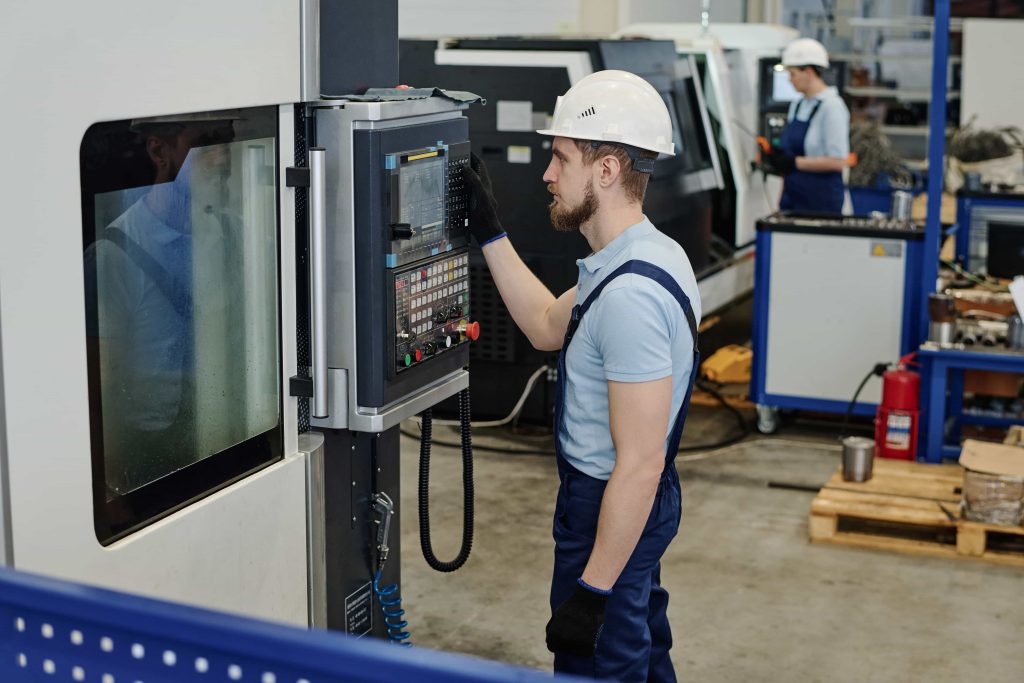
- Conduct a physical audit of 5 critical CNC machines
- Affix QR codes with unique identifiers to machine columns
- Capture baseline runtime directly from control panels
- Document recent failure patterns from the past 90 days
- Establish the current downtime baseline for ROI measurement
Phase 2: Threshold Configuration (Week 2)
- Set spindle lubrication at 1,500 hours for machines >10,000 RPM
- Configure ball screw verification after 2,500 km travel distance
- Link the tool life to cutting hours adjusted for material hardness
- Establish CMOS battery replacement at 30,000 machine-on hours
- Configure monsoon-specific adjustments for humidity-sensitive components
Phase 3: Team Training (Week 3)
- Conduct 30-minute sessions during shift changes
- Demonstrate QR scanning to access machine history
- Train on digital checklist completion for daily observations
- Show mobile alert response procedures
- Practice work order completion with photo documentation
Phase 4: Integration and Validation (Week 4)
- Link spare parts inventory to automatic reorder points
- Integrate with existing ERP for procurement workflows
- Validate the first 10 runtime-triggered work orders against actual conditions
- Adjust thresholds based on initial performance data
- Establish reporting dashboards for management visibility
Phase 5: Fleet Expansion (Weeks 5–8)
- Expand to the remaining machines after demonstrating 25% downtime reduction
- Configure seasonal adjustments for monsoon humidity spikes
- Implement advanced analytics for predictive maintenance
- Train additional technicians as system champions
- Measure ROI through reduced emergency repairs and extended component life
Conclusion
CNC machine maintenance in Indian manufacturing demands alignment with actual operational stress—not calendar convenience. Digital maintenance systems bridge the gap between OEM recommendations and shop floor reality by tracking spindle hours, axis travel, thermal cycles, and tool change counts that drive component wear.
Indian facilities implementing runtime-triggered CMMS workflows achieve 35–45% reduction in unplanned downtime, 25–30% extension of tool and component life, and consistent quality compliance required by global customers. The investment delivers measurable ROI through avoided production losses alone, typically within five to seven months in high-utilization environments.
Ready to transform your CNC maintenance from calendar guesses to machine intelligence? Contact CNC reliability specialists at contact@terotam.com for a practical assessment of your machine fleet and implementation roadmap tailored to Indian manufacturing conditions.