
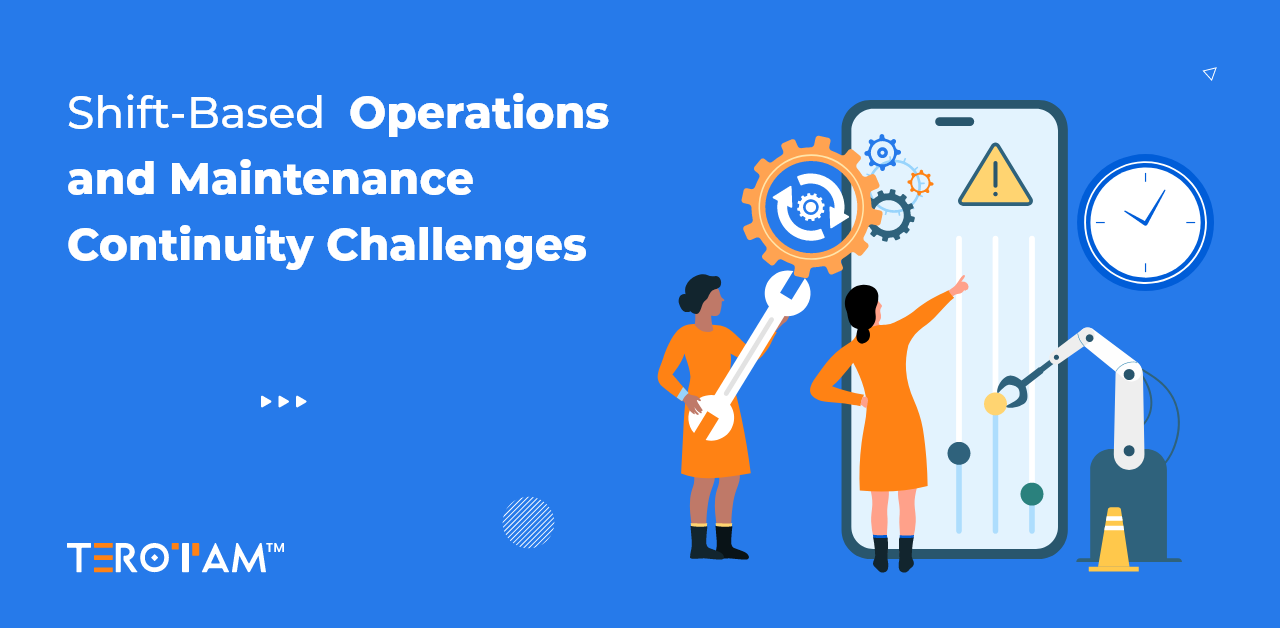
In continuous-process industries—refineries, power plants, cement facilities, food and beverage lines, mining operations, and pharmaceutical production—equipment does not stop when the shift ends. Yet critical operational knowledge often does. A night-shift technician observes abnormal vibration on a critical centrifugal pump at 2:30 a.m., mentions it during verbal handover, and logs off. The day-shift planner reviews the CMMS dashboard, sees no open work orders for that asset, and assumes all systems are nominal. By mid-morning, the pump bearing seizes, triggering a cascade failure that halts production for hours and costs tens of thousands in lost output and emergency repairs.
This is not an isolated incident. It is a systemic outcome of how shift-based operations fracture maintenance continuity by design. Without a persistent, asset-linked record that survives personnel rotation, every shift begins with partial visibility. Work stalls. Issues repeat. Teams unknowingly duplicate or contradict each other’s actions.
This article examines why maintenance continuity breaks across shifts, how to recognize the operational symptoms, what information must be preserved—and how a purpose-built CMMS restores continuity through workflow-embedded intelligence rather than procedural mandates.
Why Maintenance Continuity Fails in 24/7 Operations
Shift-based work is essential where downtime equals revenue loss. However, the structure of shift rotation introduces natural discontinuities in information flow. Most sites rely on informal or semi-formal handover mechanisms that are inherently transient:
- Verbal briefings depend on memory and attention; details degrade within minutes
- Whiteboards are erased or overwritten without archival
- Messaging apps scatter observations across unsearchable, non-integrated threads
- Paper logs are prone to loss, damage, or misfiling
None of these link observations to specific assets in a structured, auditable format. As a result, early warning signs—elevated temperature, unusual noise, minor leaks—are treated as fleeting notes rather than data points in an asset’s degradation timeline.
Compounding this, most CMMS platforms treat work orders as binary states: open or closed. They lack mechanisms to capture partial work, pending diagnostics, or contextual annotations that span multiple shifts. A multi-hour preventive task that begins at 5 a.m. may be marked “in progress,” but without granular step tracking, the next shift cannot determine whether oil was drained, filters replaced, or alignment checked. This ambiguity forces teams to either restart the entire procedure (wasting labor) or assume completion (risking omission).
The consequence is a maintenance culture that operates in silos—where each shift manages its own backlog without full visibility into prior interventions. Over time, this erodes reliability, inflates MTTR, and undermines confidence in planning systems.
Common Signs Your Shift Handover Process is Failing
While handover gaps are often invisible in daily operations, their fingerprints appear clearly in performance metrics and field behavior:
1. Repeat failures within 72 hours
An asset fails, is repaired, and fails again within three days. Root cause analysis often reveals that the initial repair addressed only symptoms, while the underlying condition (noted by night shift) was never escalated due to lack of documentation.
2. Duplicate work orders for identical issues
Both shifts independently log “leaking valve on Line 4” because neither could see the other’s ticket. This leads to double allocation of labor, unnecessary spare parts consumption, and conflicting repair attempts.
3. Inconsistent PM completion rates between shifts
Data shows 95% PM compliance for day shift but only 72% for night shift—not due to effort, but because complex, multi-step tasks are abandoned mid-cycle when shifts change and progress isn’t tracked.
4. Extended mean time to repair (MTTR)
Despite skilled technicians, MTTR remains high because new shifts spend the first 30 to 60 minutes reconstructing recent history: “Was the motor tested? Did they check the coupling? Who last touched this?” This diagnostic overhead delays actual repair.
5. Technician frustration and shadow workflows
Field teams develop informal systems—personal notebooks, photo folders on phones, private chats—to compensate for system gaps. While well-intentioned, these bypass official records and hinder organizational learning.
These patterns indicate not poor performance, but a system design gap: the absence of a unified, persistent record that transcends shift boundaries.
What Information Must Survive a Shift Change?
Continuity is not about capturing everything—it’s about preserving what matters. For maintenance to remain coherent across shifts, three categories of information must be recorded and tied directly to the physical asset:
1. Contextual observations with precision
Vague notes like “pump sounds odd” are useless. Effective handover requires:
- Exact asset tag (e.g., P-204)
- Measured parameters (bearing temp 92°C at 02:15)
- Environmental context (ambient temp 45°C, load at 85%)
This transforms subjective impressions into objective, actionable data.
2. Granular task state tracking
For multi-step procedures, the system must record:
- Which steps were completed
- Which require follow-up
- Pending actions with clear ownership (“Day shift – inspect coupling alignment; assigned to Engineer Ali”)
Without this, “in progress” is meaningless.
3. Pending diagnostics or monitoring instructions
If a fault is suspected but not confirmed, the handover must include:
- Recommended monitoring window (“Observe for 24 hours”)
- Trigger thresholds (“Alert if temp exceeds 95°C”)
- Required tools or approvals (“Await oil lab results before proceeding”)
This ensures continuity of judgment, not just activity.
When this information lives outside the CMMS—in chat, email, or memory—it is functionally lost. True continuity requires that the asset’s digital record includes the full arc of ongoing intervention, not just closed tickets.
How CMMS Software Can Restore Maintenance Continuity Across Shifts
The solution is not more meetings or stricter handover protocols. It is embedding memory into the workflow infrastructure itself. A robust CMMS must function as a living operational ledger—one that retains context across time, personnel, and location.
TeroTAM’s CMMS platform is engineered specifically for 24/7 industrial operations worldwide, where remote sites, harsh environments, and multi-shift labor models demand resilience. Its architecture addresses continuity at the point of need:
Mobile-first, offline-capable interface
Technicians in mines, offshore rigs, or underground facilities often operate without connectivity. TeroTAM’s mobile app allows them to capture voice notes, photos, meter readings, and work order updates offline. Data syncs automatically upon return to network coverage—ensuring no observation is lost due to infrastructure limitations.
QR/NFC/RFID asset tagging
Every asset can be tagged with a scannable digital ID. Scanning the tag instantly displays the asset’s complete timeline: open tickets, partial work, sensor alerts, and notes from the last three shifts. This eliminates guesswork and ensures every technician starts with full context.
Granular work order state tracking
Multi-step procedures retain progress markers. For example: “Step 3 of 7 – Oil drained; awaiting filter replacement.” This allows seamless handoff without rework or assumption.
AI-driven ticket summarization
Instead of scrolling through fragmented notes, incoming teams see a concise update: “Compressor C-102 – high discharge temp logged 03:20; cooling fins cleaned; monitor for 24 hrs.” This distills noise into signal.
Real-time operational dashboards
Supervisors view live asset status, not just ticket counts, enabling proactive escalation. If an asset shows repeated anomalies across shifts, the system flags it for engineering review before failure occurs.
Critically, TeroTAM does not add steps to the workflow. It makes the right action, the one that preserves continuity, the easiest action. When scanning a QR code pulls up full shift history in two seconds, technicians will do it. When voice logging creates a formal record without typing, adoption follows naturally.
Benefits of Continuous Maintenance in Shift-Based Environments
Organizations implementing this model observe measurable improvements:
- Reduced repeat failures: Early warnings are preserved and acted upon before escalation
- Higher first-time fix rates: Technicians begin repairs with full situational awareness
- Optimized spare parts usage: Elimination of duplicate work orders reduces inventory waste
- Faster technician onboarding: New hires reference prior-shift notes as part of asset history
- Audit-ready compliance: Timestamped, asset-linked handover records satisfy ISO 55000 and other global standards
Most importantly, night and day teams transition from parallel tracks to a unified workflow, where each shift builds on the last rather than restarting from scratch. This cultural shift, from isolated execution to collective ownership, is the true hallmark of mature reliability programs.
Putting it to the end
Shift-based operations are essential for continuous production, but they inherently risk maintenance fragmentation. The remedy is not stricter handover protocols or more supervision. It is a system architecture that preserves context across time.
When every observation, action, and pending task lives in the asset’s permanent digital record, not in ephemeral channels, teams achieve continuity by design. In demanding industrial environments worldwide, this is how reliability scales beyond individual heroics to institutional discipline.
If your maintenance process fractures at shift change, contact us at contact@terotam.com to see how TeroTAM provides the infrastructure that remembers, automatically.