Cold storage facility managers wake up to the same pressure every day. A compressor fault at two AM can spoil thousands of dollars in inventory before sunrise. Regulatory auditors demand perfect temperature logs with zero manual errors. Energy bills climb when refrigeration systems run inefficiently in sub zero conditions. These challenges do not wait for quarterly maintenance reviews or manual inspection rounds.
Digital maintenance systems built on CMMS platforms address these pressures with technical precision. IoT sensors monitor evaporator coil temperatures in real time. Predictive algorithms analyze compressor vibration signatures to flag bearing wear weeks before failure. Automated work orders route tasks to certified ammonia technicians with parts lists and safety protocols attached. The technology does not replace skilled maintenance teams. It gives them the data and tools to act before small issues become expensive emergencies.
This article explores the technical architecture behind cold storage CMMS adoption, breaks down the specific ROI drivers for refrigeration infrastructure, details integration patterns with building management systems, and provides a phased implementation roadmap for facility managers ready to reduce spoilage risk while controlling energy costs.
What Makes Cold Storage Maintenance Different From Standard Industrial Facilities?
Refrigeration systems in cold storage operate under unique physical and regulatory constraints that standard industrial maintenance platforms cannot address. Ammonia based systems require specialized technician certifications and safety protocols that generic work order tools do not enforce. Temperature excursions trigger product loss within hours, not days, demanding alert thresholds and response workflows calibrated for sub zero environments.
Compliance documentation for FDA, USDA, and HACCP audits requires timestamped records of every maintenance action, calibration event, and temperature log. Manual paper trails introduce transcription errors and delay audit preparation. Digital systems auto generate compliance reports by pulling sensor data, technician signatures, and asset histories into formatted documents that satisfy inspector requirements without last minute scrambling.
Energy consumption in cold storage correlates directly with equipment efficiency. A compressor running with low refrigerant charge or worn valves consumes significantly more power to maintain setpoint temperatures. In facilities where utility costs represent thirty to forty percent of operational spend, identifying inefficient assets through maintenance data analytics becomes a direct lever for margin improvement. Digital maintenance platforms correlate equipment performance metrics with energy metering data to flag assets driving abnormal consumption.
Which CMMS Capabilities Deliver the Highest ROI for Cold Storage Operations?
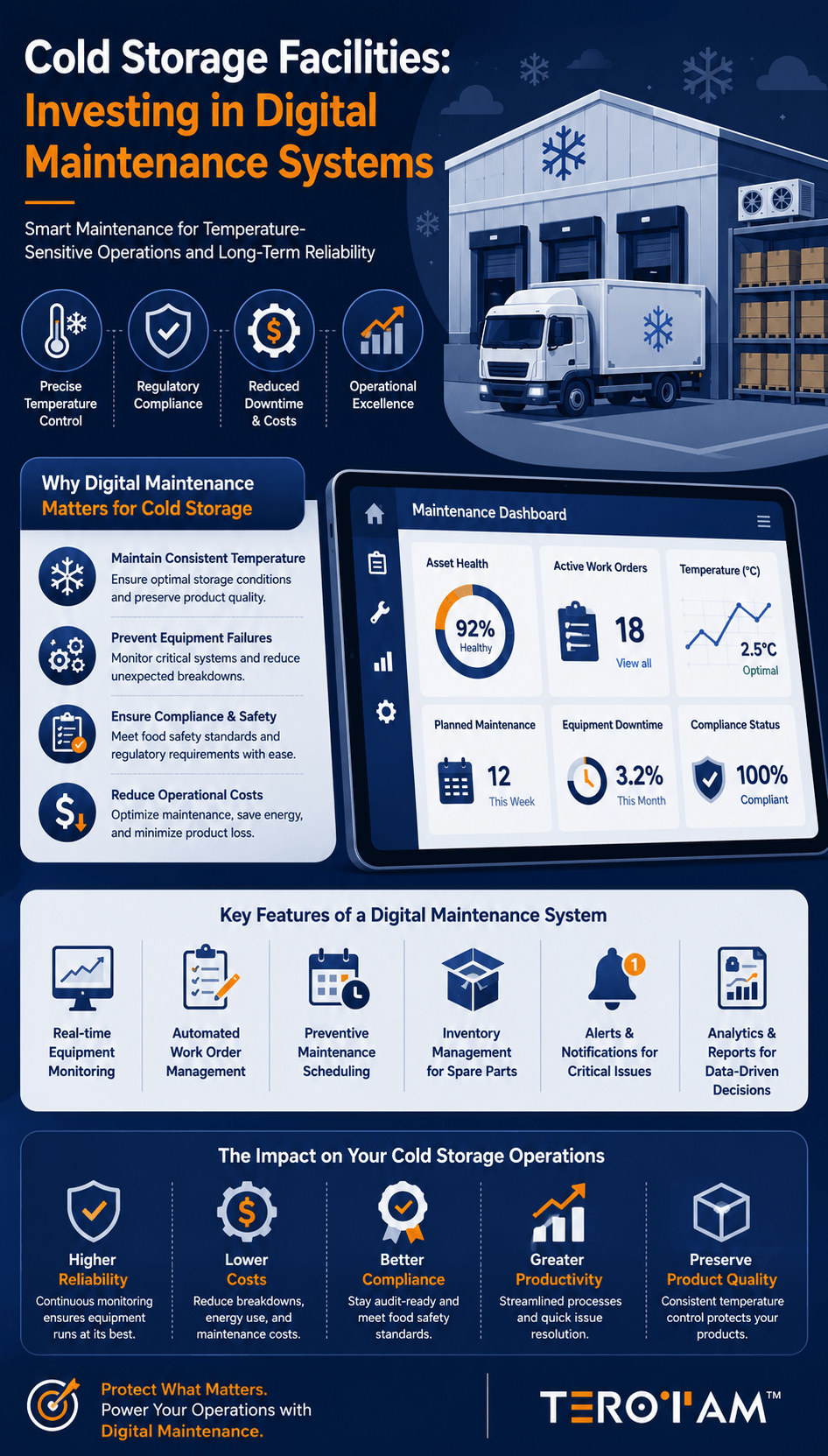
Cold storage facilities need maintenance technology engineered for temperature critical environments. A purpose built CMMS platform delivers features that directly address spoilage prevention, compliance automation, and energy optimization through specific technical implementations.
IoT temperature sensors with real time alerting prevent product loss by notifying technicians before excursions exceed compliance thresholds
Industrial grade PT100 or thermistor sensors placed at strategic points in cold rooms, blast freezers, and loading docks transmit data via LoRaWAN or cellular protocols to the CMMS platform. Alert thresholds configured slightly below regulatory limits create buffer time for technician response. When a sensor detects abnormal temperature drift, the CMMS auto generates a priority work order with asset location, recent maintenance history, and recommended troubleshooting steps routed to on-call staff via mobile app push notification.
Predictive maintenance algorithms analyze compressor vibration and refrigerant pressure patterns to schedule repairs before catastrophic failures occur
Vibration sensors mounted on compressor housings collect acceleration data at multiple frequencies. Machine learning models trained on historical cold storage equipment data identify patterns associated with bearing wear, misalignment, or refrigerant slugging. The CMMS flags assets showing early failure signatures and recommends service intervals based on remaining useful life calculations rather than fixed calendar schedules. This approach shifts maintenance from reactive emergency response to planned downtime with parts pre staged.
Automated work order routing assigns tasks to certified technicians based on location, skill set, and parts availability to reduce mean time to repair
The CMMS maintains a technician certification database tracking ammonia handling credentials, low temperature system experience, and safety training completion. When a work order triggers for an ammonia compressor, the platform filters available staff by certification status, proximity to the asset via GPS or facility zone mapping, and current workload. Parts inventory integration checks stock levels for required components and auto generates purchase requisitions if items are unavailable. This routing logic reduces mean time to repair by eliminating manual dispatch coordination and certification verification delays.
QR, NFC, or RFID asset tagging enables instant equipment history access via mobile devices so technicians see prior repairs and calibration records on site
Each refrigeration asset receives a weather resistant tag encoded with a unique identifier. Scanning the tag with a mobile device pulls the complete maintenance log, refrigerant charge history, manufacturer service bulletins, and calibration certificates from the CMMS database. Technicians working in freezer environments avoid returning to warm offices to access paperwork. Photo documentation of repairs attaches directly to the asset record, building a visual history that supports warranty claims and future troubleshooting.
AI powered analytics correlate maintenance data with energy consumption to identify inefficient assets that drive up utility costs in cold environments
The CMMS ingests metering data from facility energy management systems alongside equipment performance metrics like compressor run time, evaporator delta T, and defrost cycle frequency. Machine learning algorithms identify correlations between maintenance events and energy usage patterns. Assets showing abnormal consumption relative to peers trigger efficiency review work orders. Facility managers receive monthly reports ranking equipment by energy impact, enabling targeted investments in repairs or replacements that deliver the fastest utility cost reduction.
Compliance documentation modules auto generate audit ready reports for FDA, USDA, and third party food safety certifications without manual data entry
Every temperature log, maintenance action, technician signature, and calibration event syncs to a centralized compliance dashboard within the CMMS. Pre configured report templates format this data to match FDA 21 CFR Part 11, USDA AMS, or SQF certification requirements. One click exports generate PDF or Excel documents with timestamped audit trails, eliminating manual compilation during inspection prep. Version control ensures reports reflect the exact data state at the time of audit, reducing compliance risk from post hoc edits.
Mobile dashboards give facility managers real time visibility into asset health, open work orders, and temperature trends across multiple cold storage zones
Role based mobile views display key performance indicators like mean time to repair, temperature excursion frequency, and energy cost per cubic foot of storage. Managers monitoring multiple facilities can drill down from regional summaries to individual asset details without switching systems. Push notifications alert leadership to critical events like compressor faults or compliance threshold breaches, enabling rapid escalation when operational stakes are high.
Integration with building management systems synchronizes maintenance schedules with defrost cycles and peak energy pricing windows
API connections between the CMMS and facility BMS enable coordinated scheduling. Non critical maintenance tasks auto schedule during off peak energy rate periods or between defrost cycles to minimize operational disruption. The CMMS pulls real time equipment status from the BMS to validate that assets are in safe maintenance states before releasing work orders to technicians. This integration reduces utility costs and prevents maintenance activities from interfering with temperature control processes.
How Do Cold Storage Facilities Implement CMMS Without Disrupting Operations?
Deploying a digital maintenance system in an active cold storage facility requires phased rollout, staff training, and integration planning that preserves temperature control throughout the transition. The following technical roadmap minimizes operational risk while building momentum for full platform adoption.
Step 1: Audit critical refrigeration assets and map maintenance dependencies before selecting CMMS features
Create a detailed asset register capturing compressor models, evaporator configurations, control system types, and interdependencies. Identify which assets carry the highest spoilage risk if they fail, then prioritize those for initial digital monitoring. Document manufacturers recommended maintenance intervals, required technician certifications, and typical parts consumption to inform CMMS configuration.
Step 2: Pilot IoT sensors on high risk zones like blast freezers or loading docks to validate alert accuracy and technician response times
Install industrial grade temperature and vibration sensors on a single temperature zone to test data transmission reliability, alert threshold calibration, and work order routing logic. Measure means time from alert generation to technician acknowledgment and repair completion. Refine sensor placement, notification rules, and mobile app workflows based on pilot results before scaling to the entire facility.
Step 3: Configure automated work order templates that align with manufacturer maintenance intervals and regulatory inspection schedules
Build pre populated templates for compressor oil changes, evaporator coil cleaning, door seal inspections, and safety valve testing. Include required parts lists, safety protocols, certification checks, and documentation fields in each template. Link templates to asset records so recurring maintenance auto schedules based on runtime hours or calendar intervals without manual setup.
Step 4: Train maintenance teams on mobile app workflows so digital adoption does not slow response during temperature emergencies
Conduct hands-on training sessions in controlled environments before deploying to live freezer zones. Practice QR code scanning, work order updates, photo documentation, and parts lookup using the mobile app. Simulate emergency scenarios to validate that technicians can complete critical tasks efficiently while wearing cold weather gear. Gather feedback to refine app navigation and reduce friction during time sensitive repairs.
Step 5: Integrate with existing BMS or ERP systems to preserve historical data and avoid duplicate entry burdens
Work with IT and facility engineering teams to map data fields between the CMMS and legacy systems. Use API connections or middleware to sync asset records, maintenance histories, and energy metering data. Test integrations in a staging environment before production rollout to validate data accuracy and prevent sync conflicts that could disrupt operational reporting.
Step 6: Establish baseline metrics for downtime, energy use, and compliance audit time to measure ROI after digital rollout
Track mean time to repair, temperature excursion frequency, energy cost per cubic foot, and audit preparation hours for three months before CMMS implementation. Continue measuring the same metrics post rollout to quantify operational improvements. Use this data to refine alert thresholds, work order routing rules, and training programs for continuous optimization.
Quick Tips to Maximize CMMS Value in Cold Storage
- Tag all refrigeration assets with industrial grade QR codes rated for sub zero temperatures during initial CMMS setup
- Configure temperature alert thresholds five percent below compliance limits to create buffer time for technician response before product risk occurs
- Schedule predictive maintenance tasks during off peak energy windows identified through BMS integration to reduce utility costs while maintaining asset reliability
- Use CMMS mobile apps to capture timestamped photo documentation of repairs for compliance audits and manufacturer warranty claims
- Sync technician certification expiration dates with asset assignments to ensure only qualified personnel handle ammonia or low temperature systems
- Review energy correlation reports monthly to identify compressors or evaporators driving abnormal utility consumption relative to peer assets
- Automate compliance report generation for FDA and USDA inspections to reduce audit preparation time by seventy percent while improving data accuracy
Conclusion
Digital maintenance systems powered by CMMS platforms transform cold storage operations from reactive repair cycles to predictive asset management. Temperature monitoring, compliance automation, and energy optimization work together to protect inventory, satisfy regulators, and control operational costs in sub zero environments where margins depend on precision.
Facility managers who implement CMMS gain real time visibility into refrigeration health, reduce spoilage risk through early alerting, and streamline audit documentation without manual data entry. The result is more reliable cold chain integrity and lower total cost of ownership for critical temperature controlled assets.
Ready to deploy a CMMS solution engineered for cold storage maintenance challenges? – Drop us a line at contact@terotam.com for a technical consultation on implementing predictive monitoring, automated compliance, and energy optimized work orders for your refrigeration infrastructure.