Customer expectations have changed dramatically over the past few years. What was once considered premium service has now become a standard expectation. Consumers expect products to arrive within hours of placing an order, pushing warehouses to operate faster, longer, and with greater accuracy than ever before.
Warehouses are no longer just storage facilities. They have evolved into highly dynamic fulfillment hubs that support continuous operations, rapid inventory movement, and complex distribution networks. In this environment, even a minor equipment failure can disrupt order fulfillment schedules and impact customer satisfaction.
This article explores the major warehouse maintenance challenges organizations face in the era of same-day delivery and discusses strategies that help maintain operational efficiency, reliability, and uptime.
What is Warehouse Maintenance?
Warehouse maintenance refers to the systematic process of maintaining assets, equipment, infrastructure, and operational systems to ensure uninterrupted warehouse performance. It includes routine inspections, preventive servicing, repairs, safety checks, and asset monitoring.
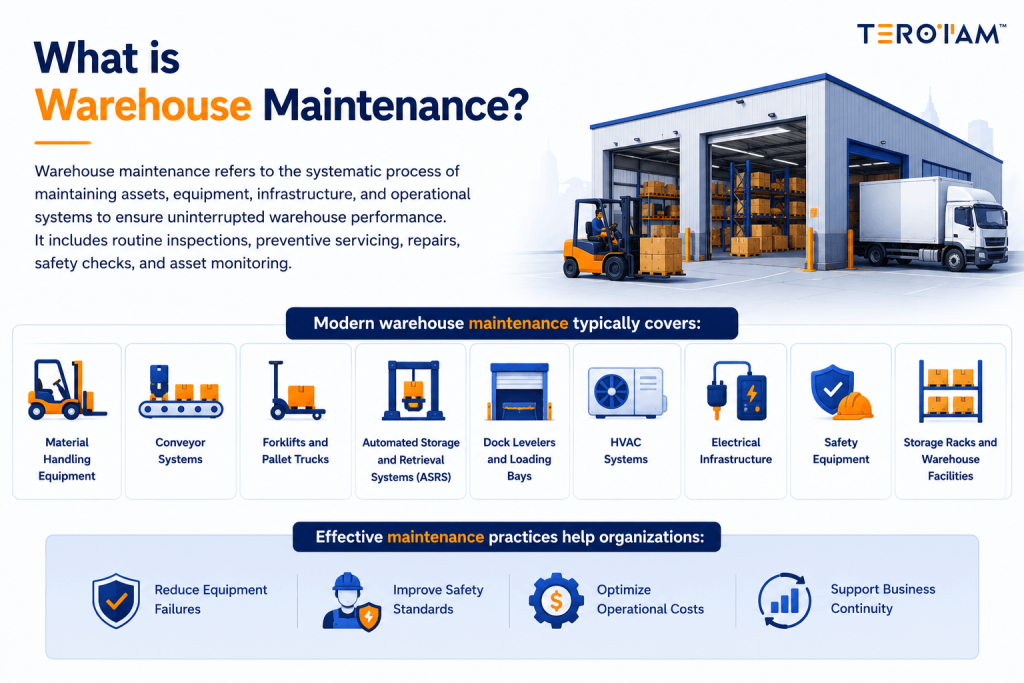
Modern warehouse maintenance typically covers:
- Material handling equipment
- Conveyor systems
- Forklifts and pallet trucks
- Automated Storage and Retrieval Systems (ASRS)
- Dock levelers and loading bays
- HVAC systems
- Electrical infrastructure
- Safety equipment
- Storage racks and warehouse facilities
Effective maintenance practices help organizations reduce equipment failures, improve safety standards, optimize operational costs, and support business continuity.
Why Same-Day Delivery is Reshaping Warehouse Operations?
The rise of same-day delivery has transformed the way warehouses function. Businesses must process larger volumes of orders within significantly shorter timeframes, leaving little room for operational disruptions.
Increased Throughput Requirements
Warehouses today process thousands of orders daily with strict delivery deadlines. This increased throughput places immense pressure on equipment, systems, and maintenance teams.
High-speed conveyors, sorting systems, and automated picking solutions operate continuously, making reliability a critical requirement for maintaining delivery commitments.
Longer Operating Hours
Many warehouses now function across multiple shifts or maintain nearly round-the-clock operations. Extended operating hours accelerate wear and tear on equipment and reduce opportunities for scheduled maintenance activities.
As equipment utilization increases, maintenance teams must find ways to balance operational demands with asset reliability.
Growing Dependence on Automation
Automation has become a key driver of warehouse efficiency. Businesses increasingly rely on robotics, automated guided vehicles, conveyor networks, and intelligent storage systems to support high-volume fulfillment.
While automation improves productivity, it also introduces additional maintenance complexity, requiring specialized skills and proactive maintenance strategies.
Major Warehouse Maintenance Challenges in the Era of Same-Day Delivery
1. Equipment Downtime Has Become More Costly Than Ever
In a same-day delivery environment, warehouse downtime can have immediate operational consequences.
A malfunctioning conveyor, a failed sorting machine, or an inoperative dock door can quickly create bottlenecks throughout the supply chain. Delayed shipments often result in missed delivery promises, dissatisfied customers, and potential revenue losses.
The cost of downtime extends beyond repairs. Organizations may experience increased labor expenses, expedited shipping charges, inventory disruptions, and reputational damage.
As delivery timelines become shorter, the tolerance for equipment failure continues to shrink.
2. Limited Maintenance Windows
Traditional maintenance schedules often rely on planned shutdowns or low-demand periods. However, warehouses supporting same-day delivery frequently operate continuously, leaving little time for routine maintenance activities.
Maintenance teams often face challenges such as:
- Difficulty scheduling preventive maintenance
- Limited access to equipment during peak operations
- Increased likelihood of postponing inspections
- Reactive repairs becoming more common
Over time, deferred maintenance increases the probability of unexpected breakdowns and reduces overall asset reliability.
3. Managing Aging Assets Alongside New Technologies
Many warehouses operate a combination of legacy systems and modern automation technologies.
Older equipment may still perform adequately but often lacks advanced monitoring capabilities. Integrating aging infrastructure with new technologies creates maintenance challenges related to compatibility, spare parts availability, and service requirements.
Organizations frequently encounter issues such as:
- Obsolete components
- Limited manufacturer support
- Difficulty sourcing replacement parts
- Increased maintenance costs
- Reduced operational efficiency
Managing this diverse asset landscape requires a structured maintenance approach supported by accurate asset information and lifecycle planning.
4. Lack of Real-Time Asset Visibility
Maintenance decisions are only as effective as the data available.
Many warehouses still depend on manual inspections, spreadsheets, and paper-based records to track asset conditions. This limited visibility makes it difficult to identify potential issues before failures occur.
Without real-time monitoring, organizations struggle to answer important questions:
- Which assets require immediate attention?
- Which equipment experiences recurring failures?
- What is the health status of critical systems?
- How much downtime is affecting warehouse performance?
Insufficient visibility often leads to reactive maintenance practices that increase costs and disrupt operations.
5. Shortage of Skilled Maintenance Personnel
Warehouse technologies are becoming increasingly sophisticated.
Technicians today are expected to understand mechanical systems, electrical components, sensors, automation controls, and digital maintenance platforms.
At the same time, industries worldwide face shortages of experienced maintenance professionals.
This skills gap creates several operational concerns:
- Slower response times
- Longer repair durations
- Increased outsourcing costs
- Knowledge loss due to workforce turnover
- Challenges in supporting advanced equipment
Organizations must invest in workforce development, digital tools, and standardized maintenance processes to address these challenges effectively.
6. Spare Parts Inventory Management Issues
Maintaining the right balance between spare parts availability and inventory costs remains a significant challenge.
Insufficient spare parts inventory can prolong repair times and increase downtime. Conversely, excessive stocking ties up capital and increases storage costs.
Warehouse operators frequently struggle with:
- Inaccurate inventory records
- Delayed procurement cycles
- Overstocked low-priority items
- Shortages of critical components
- Lack of demand forecasting
An effective spare parts management strategy ensures maintenance teams have access to essential components when they are needed most.
7. Rising Compliance and Safety Requirements
Warehouses must adhere to various safety regulations and operational standards to protect employees and maintain business continuity.
Regular inspections, equipment certifications, safety audits, and maintenance documentation have become increasingly important.
Poor maintenance practices can contribute to:
- Workplace accidents
- Regulatory penalties
- Compliance violations
- Insurance-related issues
- Increased operational risks
Maintaining detailed maintenance records and implementing structured inspection programs helps organizations remain audit-ready while enhancing workplace safety.
8. Balancing Cost Optimization With Reliability
Organizations continuously seek opportunities to reduce operating expenses, and maintenance budgets often come under scrutiny.
However, reducing maintenance investments can create long-term risks.
Delaying preventive maintenance activities may lower short-term costs but often results in:
- Increased equipment failures
- Higher repair expenses
- Reduced asset lifespan
- Unplanned downtime
- Lower operational efficiency
Warehouse leaders must balance cost control initiatives with the need to maintain asset reliability and support service-level commitments.
How Technology Helps Overcome Warehouse Maintenance Challenges
Technology plays a crucial role in helping warehouses maintain high availability and support demanding delivery expectations.
Predictive Maintenance
Predictive maintenance enables organizations to identify potential failures before they occur.
Using IoT sensors and condition-monitoring technologies, businesses can monitor factors such as vibration, temperature, energy consumption, and equipment performance.
This approach allows maintenance teams to intervene at the right time, minimizing unexpected downtime and optimizing maintenance schedules.
CMMS Implementation
A Computerized Maintenance Management System (CMMS) provides a centralized platform for managing maintenance operations.
A CMMS helps warehouses:
- Schedule preventive maintenance
- Automate work order creation
- Track maintenance history
- Monitor asset performance
- Manage spare parts inventory
- Improve maintenance planning
Centralized maintenance management enhances visibility and supports better decision-making.
Mobile Maintenance Solutions
Mobile applications enable technicians to access information directly from the warehouse floor.
With mobile maintenance capabilities, teams can:
- Receive work orders instantly
- Update task status in real time
- Access equipment manuals
- Capture inspection data digitally
- Improve communication between departments
This reduces delays and increases maintenance efficiency.
Data-Driven Decision Making
Analytics provide valuable insights into asset performance and maintenance effectiveness.
Organizations can evaluate key metrics such as:
- Equipment availability
- Maintenance costs
- Failure trends
- Work order completion rates
- Asset lifecycle performance
These insights help maintenance leaders optimize resources and improve long-term operational planning.
Best Practices for Modern Warehouse Maintenance
Maintaining warehouse efficiency in the age of same-day delivery requires a proactive and well-structured maintenance strategy. Organizations that focus on preventive measures, asset visibility, and continuous improvement can minimize downtime, extend equipment life, and ensure seamless order fulfillment operations.
- Establish preventive maintenance schedules to reduce unexpected equipment failures.
- Prioritize maintenance activities for critical assets that directly impact warehouse throughput.
- Implement digital asset tracking systems to improve visibility and maintenance planning.
- Maintain optimal spare parts inventory to support faster repairs and minimize delays.
- Use condition monitoring technologies to detect issues before they escalate into failures.
- Conduct regular safety inspections to maintain compliance and workplace safety standards.
- Train maintenance teams continuously to keep pace with evolving warehouse technologies.
- Standardize maintenance procedures to improve consistency and technician productivity.
- Track maintenance KPIs regularly to identify improvement opportunities and enhance asset reliability.
How TeroTAM Helps Warehouses Maintain High Availability
TeroTAM enables organizations to modernize warehouse maintenance operations through a centralized and data-driven platform.
With TeroTAM, businesses can:
- Digitize maintenance workflows
- Automate preventive maintenance schedules
- Monitor asset performance in real time
- Manage spare parts inventory efficiently
- Streamline work order management
- Improve technician productivity
- Track maintenance KPIs through interactive dashboards
By implementing proactive maintenance practices supported by technology, warehouses can reduce downtime, improve asset reliability, and sustain the operational agility required to meet same-day delivery expectations.
Summing it up
As same-day delivery continues to redefine customer expectations, warehouses must operate with greater speed, reliability, and efficiency than ever before. Unexpected equipment failures, limited maintenance windows, aging infrastructure, and increasing automation demands make proactive maintenance essential for sustaining operational performance and meeting delivery commitments.
Adopting modern maintenance practices supported by digital solutions can help organizations reduce downtime, improve asset reliability, and enhance warehouse productivity. With TeroTAM, businesses can streamline maintenance operations, gain real-time visibility into asset performance, and build a resilient warehouse ecosystem ready for today’s fast-paced fulfillment environment. To learn how TeroTAM can support your warehouse maintenance initiatives, reach out to us at contact@terotam.com