Annual Maintenance Contracts (AMCs) are designed to keep business-critical assets operating efficiently while reducing unexpected repair costs and downtime. From HVAC systems and production equipment to IT infrastructure and medical devices, AMCs provide organizations with access to timely maintenance, technical support, and preventive servicing. Yet, many businesses fail to manage these contracts effectively.
The challenge is not the absence of AMCs but the lack of visibility into them. Contracts are often scattered across departments, renewal dates are overlooked, and maintenance records remain disconnected from the assets they support. These gaps create operational blind spots that lead to avoidable expenses, delayed maintenance, and unnecessary disruptions. This article explores why AMC tracking continues to be a major challenge, the risks businesses face, and how a centralized maintenance management system can solve the problem.
What is AMC Tracking and Why Does It Matter?
AMC tracking is the process of managing every aspect of an Annual Maintenance Contract throughout its lifecycle. It includes recording contract details, mapping contracts to specific assets, monitoring renewal dates, tracking service visits, maintaining vendor information, and ensuring compliance with agreed service level commitments.
Organizations generally work with different types of AMCs depending on their operational requirements:
- Comprehensive AMCs covering both labor and spare parts.
- Non-comprehensive AMCs covering labor while charging separately for parts.
- OEM AMCs provided directly by the equipment manufacturer.
- Third-party AMCs managed by external service providers.
These contracts often cover critical assets such as:
- Manufacturing equipment
- HVAC systems
- Electrical infrastructure
- Medical devices
- IT hardware and networking equipment
- Elevators and escalators
- Fire safety systems
- Commercial kitchen equipment
Proper AMC tracking ensures every asset receives timely maintenance, vendors fulfill their contractual obligations, and organizations avoid unexpected service interruptions. It also gives maintenance teams complete visibility into contract status, service history, and future renewal requirements.
Why AMC Tracking Becomes a Blind Spot?
Managing a handful of contracts may seem straightforward, but the situation changes dramatically as organizations expand across multiple departments, facilities, or geographic locations. Hundreds of assets, multiple vendors, and varying contract terms make manual tracking increasingly difficult. Without a structured process, AMC management gradually turns into an operational blind spot.
Scattered Contract Records
One of the most common issues is fragmented documentation. Some contracts are stored in email inboxes, others are saved on shared drives, while a few remain as printed copies in filing cabinets.
When maintenance teams need immediate access to contract details during an equipment failure, valuable time is wasted searching for information instead of resolving the issue. The lack of a centralized repository also increases the risk of outdated or duplicate contract records.
Missed Renewal Dates
Many organizations continue to rely on calendar reminders or manual spreadsheets to track contract expirations. If a responsible employee changes roles, leaves the company, or simply overlooks a reminder, the contract may expire without anyone noticing.
Expired AMCs can result in:
- Unexpected repair expenses
- Delayed vendor support
- Equipment downtime
- Business interruptions
- Emergency procurement processes
Even a short lapse in coverage can significantly impact operational continuity.
Lack of Asset-to-AMC Mapping
Knowing that an organization has an AMC is not enough. Teams also need to know exactly which assets are covered.
Without proper asset mapping, maintenance teams often struggle to answer questions such as:
- Is this machine still under AMC?
- Which vendor should be contacted?
- What services are included?
- Are replacement parts covered?
This uncertainty delays maintenance activities and often leads to unnecessary expenses.
No Visibility into Vendor Performance
Signing an AMC is only the beginning of the relationship. Organizations also need to monitor whether vendors are delivering services according to agreed timelines.
Without performance tracking, businesses cannot measure:
- Response time
- Resolution time
- Preventive maintenance completion
- Service quality
- SLA compliance
Poor-performing vendors may continue receiving contract renewals simply because no performance data exists for evaluation.
Multiple Vendors Across Locations
Large enterprises often work with different vendors for different facilities or asset categories.
For example:
- One vendor manages HVAC systems.
- Another handles electrical maintenance.
- A third supports IT infrastructure.
- Additional vendors may manage elevators, fire safety systems, or specialized manufacturing equipment.
Each vendor follows different renewal schedules, pricing structures, and service commitments. Coordinating these contracts manually quickly becomes overwhelming.
Manual Follow-Ups
Many maintenance teams still depend on phone calls, emails, spreadsheets, and personal reminders to schedule preventive visits or request vendor support.
Besides consuming valuable administrative time, this manual approach increases the likelihood of missed service visits, delayed maintenance, and inconsistent documentation.
Hidden Operational Costs of Poor AMC Tracking
Poor AMC management rarely creates immediate visible problems. Instead, its impact builds gradually, increasing maintenance costs and reducing operational efficiency over time.
Increased Equipment Downtime
When contracts expire unnoticed or preventive maintenance is delayed, equipment failures become more frequent. Unexpected downtime disrupts production schedules, customer service, and overall business operations.
Higher Emergency Repair Costs
Emergency repairs often cost considerably more than planned maintenance. If an expired AMC leaves an asset uncovered, organizations may have to pay premium charges for urgent repairs, spare parts, and technician visits.
Duplicate AMC Purchases
Without centralized visibility, different departments may unknowingly purchase overlapping contracts for the same equipment. This results in unnecessary spending while offering little additional value.
Warranty and AMC Confusion
Many organizations struggle to distinguish between assets under manufacturer warranty and those covered by AMC agreements.
This confusion can lead to:
- Incorrect vendor engagement
- Delayed repairs
- Unnecessary maintenance expenses
- Missed warranty claims
Missed Preventive Maintenance Visits
Preventive maintenance is one of the primary benefits of an AMC. However, when scheduled visits are not tracked properly, vendors may miss maintenance activities without immediate detection.
Over time, neglected maintenance shortens equipment lifespan and increases breakdown frequency.
Compliance and Audit Challenges
Industries such as healthcare, pharmaceuticals, manufacturing, and facility management often require documented maintenance records during audits.
Scattered documentation makes it difficult to demonstrate compliance, increasing audit preparation time and creating unnecessary risks.
Budget Overruns
Poor AMC visibility often results in unplanned maintenance spending. Emergency repairs, contract renewals, duplicate purchases, and equipment replacements place additional pressure on maintenance budgets.
Organizations lose the opportunity to forecast expenses accurately and optimize maintenance investments.
Warning Signs Your Organization Has an AMC Tracking Problem
Many businesses do not realize their AMC management process is inefficient until a costly issue occurs. However, several warning signs indicate that improvements are needed.
If any of the following situations sound familiar, your organization may already have an AMC tracking problem:
- Employees regularly ask whether an asset is covered under AMC.
- Contract renewal reminders depend on individual calendar entries.
- Vendor contact information is difficult to locate.
- Service reports are stored in multiple folders or email conversations.
- Management cannot generate an instant report showing active and expired AMCs.
- Preventive maintenance schedules are frequently delayed.
- Maintenance costs continue to rise despite having multiple active AMCs.
- Vendors are renewed without evaluating their past performance.
These issues often indicate the absence of centralized contract visibility rather than the absence of maintenance contracts themselves.
Best Practices for Effective AMC Tracking
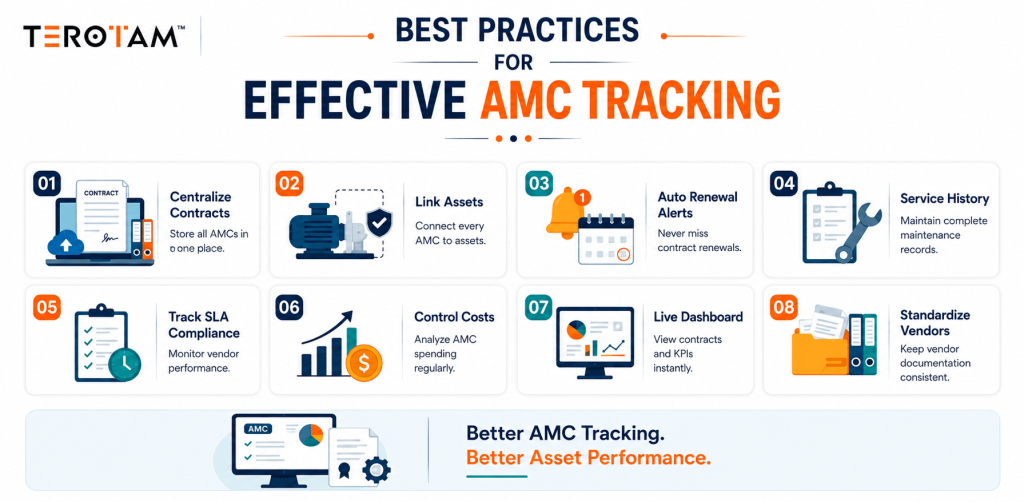
Improving AMC tracking requires more than digitizing contracts. Organizations need standardized processes that connect contracts, assets, vendors, and maintenance activities into one unified system.
Some proven best practices include:
Centralize All AMC Contracts
Store every contract in a single digital repository where authorized teams can quickly access contract terms, renewal dates, vendor details, and supporting documents.
Link Every Contract to Specific Assets
Every AMC should be directly associated with the assets it covers. This eliminates confusion during maintenance requests and simplifies asset lifecycle management.
Configure Automated Renewal Alerts
Set up automated notifications well before contract expiration. This provides sufficient time to review vendor performance, negotiate pricing, and renew contracts without service interruptions.
Monitor SLA Compliance
Track vendor response times, preventive maintenance schedules, and issue resolution against agreed service levels. Performance data enables objective vendor evaluation during contract renewal.
Maintain Complete Service History
Every maintenance visit, repair, inspection, and replacement should be recorded against both the asset and the corresponding AMC. This creates a complete maintenance history for future reference.
Analyze AMC Costs
Regularly review contract expenses alongside maintenance outcomes. Understanding cost trends helps organizations identify opportunities for optimization and negotiate better agreements.
Create Management Dashboards
Real-time dashboards provide decision-makers with visibility into contract status, upcoming renewals, vendor performance, maintenance activities, and operational risks.
Standardize Vendor Documentation
Ensure every vendor follows a consistent process for submitting service reports, inspection records, invoices, and maintenance documentation. Standardization simplifies audits and improves operational transparency.
How a CMMS Simplifies AMC Tracking
Modern Computerized Maintenance Management Systems (CMMS) eliminate many of the challenges associated with manual AMC management. Instead of maintaining disconnected spreadsheets and folders, organizations can manage the complete AMC lifecycle from a centralized platform.
A solution like TeroTAM CMMS enables organizations to:
- Store all AMC contracts in a centralized digital repository.
- Map contracts directly to individual assets.
- Configure automated renewal notifications.
- Manage vendor information from a single platform.
- Track SLA compliance and vendor performance.
- Link work orders with corresponding AMC coverage.
- Maintain complete service history for every asset.
- Generate dashboards showing active, expiring, and expired contracts.
- Manage contracts across multiple facilities and locations.
- Keep audit-ready documentation available whenever required.
With centralized visibility, maintenance managers no longer need to rely on manual reminders or scattered documentation. Every stakeholder can access accurate contract information, enabling faster decisions and more efficient maintenance planning.
Industries That Benefit the Most from AMC Tracking
Although every organization with physical assets can benefit from AMC management, some industries experience particularly significant advantages due to the volume and critical nature of their equipment.
Manufacturing relies on AMCs to keep production equipment running efficiently while reducing costly downtime.
Healthcare requires continuous maintenance of diagnostic equipment, laboratory instruments, and life-saving medical devices where uninterrupted availability is essential.
Retail and Multi-site Businesses manage hundreds of stores with equipment such as HVAC systems, refrigeration units, security devices, and electrical infrastructure that require coordinated contract management.
Facility Management companies oversee diverse assets across multiple client locations, making centralized AMC tracking essential for maintaining service quality.
Hospitality organizations depend on well-maintained HVAC systems, elevators, kitchen equipment, and guest facilities to deliver consistent customer experiences.
Educational Institutions maintain classrooms, laboratories, campus utilities, surveillance systems, and IT infrastructure that require scheduled servicing throughout the year.
IT and Data Centers depend on uninterrupted operation of servers, UPS systems, cooling infrastructure, networking equipment, and backup power systems, making timely AMC management critical.
Commercial Real Estate organizations oversee elevators, fire safety systems, electrical infrastructure, water management systems, and common facility equipment that require ongoing maintenance and regulatory compliance.
Summing it up
Annual Maintenance Contracts are intended to reduce operational risk, improve asset reliability, and control maintenance costs. However, when contract information is fragmented, renewal schedules are missed, and vendor performance remains untracked, AMCs become another source of operational uncertainty instead of a business advantage.
A centralized CMMS transforms AMC tracking from a reactive administrative task into a proactive maintenance strategy. With complete visibility into contracts, assets, vendors, service history, and renewal schedules, organizations can reduce downtime, improve accountability, and make better maintenance decisions.
Looking to simplify AMC tracking and never miss a renewal again? – TeroTAM CMMS helps you manage contracts, vendors, assets, SLAs, and maintenance activities from a single platform. Contact us at contact@terotam.com to schedule a personalized demo.