Imagine a critical machine stops working during a busy production shift. The maintenance team arrives to investigate, but nobody knows when the machine was last serviced, which components were replaced, or whether the same fault occurred before.
The team searches through spreadsheets, old emails, service reports, and paper checklists. Some records are available, but others are missing or incomplete. The technician must now diagnose the problem without a clear picture of the asset’s past.
This situation is more common than many organizations realize. Equipment may have a unique asset number and a scheduled maintenance plan, yet its actual service history remains scattered across different systems.
An asset without a reliable maintenance history is harder to maintain, evaluate, and manage throughout its lifecycle. The consequences go beyond paperwork. They affect repair decisions, equipment reliability, audit readiness, maintenance costs, and long-term asset planning.
When Does an Asset Maintenance Record Become Unreliable?
A maintenance history is a chronological record of the work performed on an asset, the problems identified, the components replaced, and the results of inspections or tests.
A reliable record should help someone understand what happened to the equipment, when it happened, who performed the work, and what was done to resolve the issue. However, not every maintenance record provides this level of information.
- A work order is marked complete, but the technician’s findings are not recorded.
- A replacement motor is purchased, but the record does not identify the machine in which it was installed.
- A service provider submits an invoice without a detailed service report.
- Equipment moves to another facility, but its maintenance documents remain with the previous site.
- An inspection is recorded as completed, but the actual readings and identified defects are missing.
These gaps make it difficult to verify the asset’s maintenance history. The problem becomes more serious when different records contradict each other. A spreadsheet may show that a service was completed in March, while the technician’s report indicates April. Without a dependable source of information, managers cannot easily determine which record is correct.
A reliable maintenance history should connect the asset register, work orders, inspection results, parts usage, service reports, and corrective actions. The objective is not simply to store documents. It is to maintain a consistent, traceable record of the asset’s condition and maintenance activities.
The Next Technician Has to Start from Scratch
When maintenance history is missing, technicians lose one of their most useful diagnostic resources: knowledge of previous failures and repairs.
Suppose an industrial pump repeatedly loses pressure. The technician replaces a seal, tests the pump, and returns it to service. Two weeks later, the same problem occurs.
If the previous repair details are unavailable, the technician may treat the incident as a new fault. The team might replace another seal without investigating whether the real cause is excessive pressure, misalignment, contamination, or a worn bearing. A complete maintenance history could help the technician identify the recurring pattern and investigate the underlying cause.
The same problem can affect many types of equipment:
- HVAC systems: Repeated compressor faults may go unnoticed across separate service visits.
- Generators: Previous starting problems may not be connected to a recurring battery or charging issue.
- Production machinery: Repeated motor or bearing failures may not trigger a root-cause investigation.
- Building equipment: Similar complaints may continue because previous corrective actions are not documented.
Missing records can also increase troubleshooting time. Technicians may need to repeat inspections, contact previous service providers, or perform additional tests to establish the equipment’s condition.
This creates a knowledge gap whenever staff members change roles, contractors change, or assets move between locations. Reliable maintenance records allow the next technician to build on previous findings instead of repeating the same investigation.
You Cannot Make Confident Decisions About an Asset’s Condition
An asset’s current operating condition does not tell the complete story. A machine may be running normally today, but it could have experienced repeated breakdowns, several major component replacements, or unresolved defects over the previous year. Without reliable records, these issues may not be visible to the maintenance manager.
Is the asset experiencing repeated failures?
Failure history helps teams identify whether a problem is isolated or recurring. One motor failure may be an ordinary maintenance event. Multiple motor failures over a short period could indicate a deeper problem involving operating conditions, alignment, electrical supply, lubrication, or installation. Without historical work orders and repair details, identifying that pattern becomes difficult.
Is the asset becoming more expensive to maintain?
Maintenance records help managers compare repair costs, replacement parts, labor hours, and downtime over time. If these details are missing, the organization may underestimate the cost of keeping an older machine operational. It may continue approving individual repairs without recognizing the wider financial trend.
Is the asset still suitable for its intended use?
Age alone is not a reliable measure of remaining useful life. Operating hours, environmental conditions, maintenance quality, failure history, and the availability of replacement parts also matter. Two similar machines installed in the same year may have very different maintenance requirements.
An asset with complete records provides stronger evidence for repair, refurbishment, or replacement decisions. An asset with missing records leaves managers with greater uncertainty.
Warranty Claims, Audits, and Compliance Become Harder to Support
Maintenance records are important not only for technicians and operations managers but also for finance, procurement, quality, safety, and compliance teams.
When an asset develops a fault, the organization may need to demonstrate that required maintenance was performed, a component was replaced, or a corrective action was completed. Without supporting documentation, proving what happened becomes more difficult.
Warranty claims may be harder to substantiate
A manufacturer or service provider may request service dates, inspection reports, fault descriptions, or component replacement details when assessing a warranty claim. If these records are missing, the organization may struggle to establish the relevant maintenance history. This does not automatically invalidate a warranty, but it can complicate the claim and delay resolution.
Audits may reveal documentation gaps
Some equipment and industries have specific inspection, testing, and recordkeeping requirements. Where such requirements apply, incomplete records can make it difficult to demonstrate that the required activities were performed. For example, a maintenance manager may know that a safety inspection took place, but the organization may not have the signed report or recorded test results needed to support that claim.
Corrective actions may lack traceability
When an inspection identifies a defect, the organization should be able to trace the issue from identification through repair and verification. If the original finding, work order, or completion evidence is missing, managers may be unable to confirm whether the issue was properly resolved.
A dependable maintenance history creates an evidence trail that supports accountability and helps organizations demonstrate their maintenance practices.
The Hidden Problem: No One Can See the Full Asset Lifecycle
The impact of missing maintenance history becomes more significant when an organization manages hundreds or thousands of assets across multiple facilities. Maintenance records are essential for understanding an asset’s total cost of ownership, performance trends, and remaining useful life.
Consider two identical air compressors purchased in the same year.
Although both compressors may be operational, the organization has different levels of confidence in its decisions about them.
- Budgeting: Historical spending may not reflect the actual cost of maintaining equipment.
- Capital planning: Replacement decisions may be delayed or made without sufficient evidence.
- Asset benchmarking: Similar machines cannot be compared fairly when their usage and repair records are incomplete.
- Root-cause analysis: Recurring failures across equipment types or locations may remain hidden.
- Procurement: Teams may struggle to evaluate whether a model has performed reliably over its service life.
Reliable maintenance data helps organizations move from reacting to individual breakdowns toward understanding asset performance over time.
How Can You Rebuild a Reliable History for Existing Assets?
Organizations do not need to abandon an asset because its historical records are incomplete. They can rebuild the available history and establish a verified starting point for future maintenance. The important point is to distinguish confirmed information from assumptions.
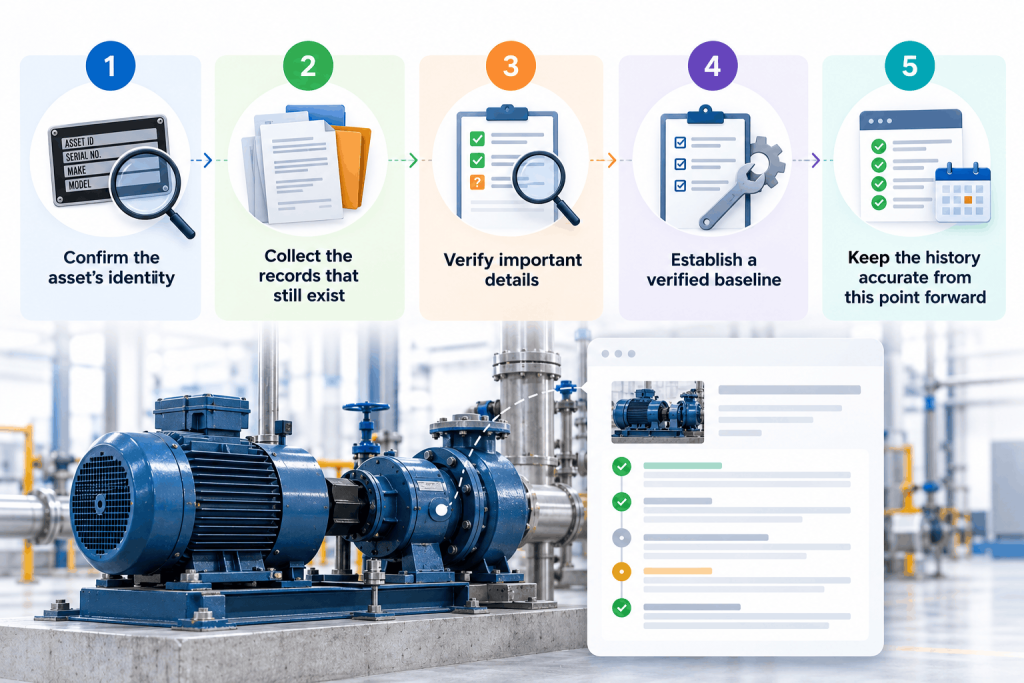
Step 1: Confirm the asset’s identity
Verify the asset ID, serial number, make, model, installation date, location, and current status. This prevents service records from being attached to the wrong machine, particularly when several assets share the same model.
Step 2: Collect the records that still exist
Search previous work orders, maintenance registers, technician service reports, supplier and contractor invoices, inspection and testing documents, spare parts issue records, warranty and installation documents, and equipment readings or alarm logs where available. Match each record to the correct asset using reliable identifiers wherever possible.
Step 3: Verify important details
Confirm recent service activities and known defects with technicians, supervisors, or service providers when possible. If the exact service date or repair details cannot be confirmed, the record should remain marked as unknown or unverified. Estimated dates should not be presented as established facts.
Step 4: Establish a verified baseline
When the historical picture is incomplete, assess the asset’s current condition and identify the inspections, tests, or maintenance activities required under applicable procedures and manufacturer guidance. Record the findings, unresolved defects, and corrective actions.
Step 5: Keep the history accurate from this point forward
Every new maintenance activity should update the asset’s record. Work orders should capture what was found, what was done, which parts were used, and whether the equipment was verified as ready for service.
Rebuilding history is useful, but maintaining accurate records consistently is what prevents the same problem from returning.
How Does a CMMS Keep Asset History Connected and Traceable?
A Computerized Maintenance Management System (CMMS) helps organizations maintain asset information and connect it with maintenance activities. Instead of relying on separate spreadsheets, emails, and paper records, teams can use a centralized system to manage the asset’s maintenance history.
A CMMS can support reliable recordkeeping through several capabilities:
- A unique record for every asset: Equipment information, location, identification details, and maintenance history can be linked to the correct asset.
- Work orders connected to asset history: Repairs, inspections, technician findings, and corrective actions can be recorded against individual machines.
- Document management: Relevant service reports, inspection documents, and other supporting records can be stored or linked to the asset, depending on the system’s capabilities.
- Searchable maintenance history: Teams can review previous work, recurring faults, and service activities without searching through multiple disconnected records.
- Maintenance reporting: Managers can use available data to identify repeat failures, review maintenance costs, monitor overdue activities, and compare equipment performance.
For organizations managing multiple facilities, a CMMS such as TeroTAM can help centralize asset information and provide greater visibility into maintenance activities.
However, software alone cannot make unreliable information accurate. Teams still need consistent data entry, clear asset identification, documented procedures, and appropriate verification of completed work. The value comes from combining a structured system with disciplined maintenance recordkeeping.
Summing it up
An asset’s maintenance history is much more than a collection of service reports. It is a record of how the equipment has performed, what problems it has experienced, and what has been done to keep it operational.
When that history is missing or unreliable, technicians lose valuable diagnostic information, managers face greater uncertainty, and organizations may struggle to justify repair, replacement, warranty, and compliance decisions.
The solution starts with identifying each asset correctly, recovering available records, verifying what can be confirmed, and documenting new maintenance activities consistently.
A CMMS can support this process by connecting asset information, work orders, service records, and maintenance reports in one system.
Want to improve asset history tracking across your organization? Contact TeroTAM at contact@terotam.com to learn how structured asset and maintenance records can support better maintenance decisions and lifecycle management.