For manufacturers, spare parts inventory is a constant balancing act. Holding excessive inventory ties up working capital, increases storage costs, and creates the risk of obsolete stock. On the other hand, maintaining insufficient inventory can result in extended equipment downtime, missed production targets, and dissatisfied customers. Finding the right balance is one of the biggest challenges maintenance and inventory managers face.
The answer is not to stock every spare part or minimize inventory at all costs. Instead, manufacturers should prioritize spare parts based on the criticality of the assets they support. A risk-based approach ensures that essential components are always available for business-critical equipment while reducing unnecessary inventory for less important assets. This article explains how manufacturers can build an effective spare parts strategy by using asset criticality as the foundation of inventory planning.
Why Asset Criticality Should Drive Spare Parts Decisions?
Not every machine on the factory floor has the same impact on business operations. Some assets are directly linked to production output, while others play a supporting role. Treating all equipment equally when planning spare parts inventory often leads to inefficient spending and increased operational risks.
Consider two different scenarios. A conveyor motor on the primary production line fails unexpectedly, bringing manufacturing to a complete halt. In another case, an air conditioning unit in an administrative office stops working. While both situations require maintenance, the financial and operational consequences are vastly different.
This is why manufacturers should base inventory decisions on business risk rather than the purchase price of equipment. The more critical an asset is to production, safety, regulatory compliance, or customer commitments, the greater the need to ensure that essential spare parts are readily available.
Risk-based inventory management enables organizations to focus their resources where they matter most, improving equipment reliability while avoiding unnecessary inventory investments.
Step 1: Identify Your Most Critical Assets
Before prioritizing spare parts, manufacturers must first understand which assets have the greatest impact on operations. Asset criticality is determined by evaluating how equipment failure affects business performance.
Several factors should be considered during this assessment.
Impact on Production
If an asset fails, does production stop completely, or can operations continue with reduced capacity? Equipment that directly affects manufacturing output should receive the highest priority.
Safety Risks
Some equipment protects employees, contractors, and visitors. Failure of safety systems, emergency equipment, or hazardous process controls can expose organizations to significant operational and legal risks.
Regulatory Compliance
Industries such as pharmaceuticals, food processing, healthcare, and chemical manufacturing operate under strict regulatory requirements. Equipment failures that compromise compliance should receive higher criticality scores.
Repair Lead Time
Some replacement components are available within a day, while others require several weeks or months to procure. Long procurement lead times increase the importance of maintaining spare parts in inventory.
Availability of Backup Equipment
If another machine can immediately replace a failed asset, the operational risk decreases. However, assets with no backup require stronger spare parts planning.
Cost of Downtime
Downtime affects far more than maintenance budgets. It can interrupt production schedules, delay customer deliveries, increase overtime costs, and reduce profitability. Assets with the highest downtime costs deserve greater inventory support.
Many manufacturers use an asset criticality matrix that scores equipment based on these factors. The combined score helps maintenance teams rank assets according to operational importance and prioritize inventory accordingly.
Step 2: Classify Spare Parts into Priority Levels
Once assets have been ranked, the next step is to categorize spare parts according to the level of operational risk they represent. A structured classification system helps organizations invest in inventory where it provides the greatest value.
Critical Spare Parts
Critical spare parts support equipment whose failure immediately disrupts operations or creates safety concerns.
These components typically have the following characteristics:
- Production stops if the part is unavailable.
- Procurement lead times are lengthy.
- Suitable alternatives do not exist.
- Equipment has no backup.
- Downtime costs are significant.
These parts should always be available in inventory, even if they are used infrequently. Their carrying cost is usually far lower than the financial impact of prolonged production interruptions.
Important Spare Parts
Important spare parts support equipment that influences operational efficiency but does not immediately halt production.
These components generally:
- Affect productivity rather than complete output.
- Have moderate procurement lead times.
- Can be sourced within a reasonable timeframe.
- May have temporary workarounds.
Manufacturers should maintain controlled inventory levels for these parts while monitoring consumption patterns to prevent shortages.
Routine Spare Parts
Routine spare parts are inexpensive, widely available, and easy to replace.
Examples include standard fasteners, filters, belts, switches, and commonly available electrical components.
These items may be stocked in limited quantities or purchased when required, depending on historical usage and supplier availability.
By separating inventory into priority categories, organizations can reduce excess stock while ensuring that business-critical equipment remains protected.
Step 3: Evaluate More Than Just Asset Criticality
Although asset criticality provides an excellent starting point, it should not be the only factor influencing inventory decisions. Two equally critical machines may require completely different spare parts strategies.
Several additional considerations should influence stocking decisions.
Supplier Lead Time
A component with a twelve-week delivery period requires a different inventory strategy than one available within twenty-four hours.
Failure Frequency
Components that fail regularly deserve higher inventory priority than parts that rarely require replacement.
Part Cost
High-value components should be evaluated carefully. In some situations, maintaining one spare may be sufficient, while in others alternative procurement strategies may be more economical.
Shelf Life
Certain spare parts deteriorate during storage. Rubber seals, batteries, lubricants, adhesives, and electronic components may have limited shelf lives, requiring careful inventory management.
Storage Requirements
Some parts require climate-controlled storage, specialized handling, or additional security. Storage costs should be considered when determining inventory levels.
Risk of Obsolescence
Manufacturers frequently upgrade equipment, making some spare parts obsolete. Inventory planning should consider equipment lifecycle and future replacement plans.
Historical Consumption
Maintenance history provides valuable insights into which parts are used frequently and which remain untouched for years. Consumption trends help organizations establish accurate reorder quantities.
Vendor Reliability
Reliable suppliers with consistent delivery performance reduce the need for excessive inventory. Less dependable suppliers often require additional safety stock to minimize operational risks.
Evaluating these factors alongside asset criticality enables manufacturers to make more balanced and cost-effective inventory decisions.
Common Mistakes Manufacturers Make
Many organizations invest heavily in spare parts inventory but still experience production delays and unexpected equipment failures. In most cases, the problem lies not in the quantity of inventory but in how it is managed.
Stocking Every Spare “Just in Case”
Some businesses purchase large quantities of spare parts to avoid shortages. While this may appear to reduce risk, it often results in excessive inventory carrying costs, unused stock, and obsolete materials.
Treating Every Asset Equally
Allocating identical inventory budgets to all equipment ignores operational priorities. Critical production assets require far greater inventory attention than low-risk support equipment.
Ignoring Historical Maintenance Data
Past maintenance records reveal valuable information about recurring failures and frequently replaced components. Organizations that fail to analyze this data often make inaccurate purchasing decisions.
Depending on Manual Inventory Tracking
Spreadsheets and manual inventory logs become increasingly difficult to manage as operations grow. Human errors, delayed updates, and missing records reduce inventory accuracy and make planning more difficult.
Never Reviewing Inventory Strategy
Production requirements, supplier performance, and equipment conditions change over time. Organizations that never reassess their spare parts strategy often continue stocking items that are no longer necessary while overlooking emerging risks.
Building a Risk-Based Spare Parts Strategy
Successful manufacturers recognize that spare parts management is an ongoing process rather than a one-time exercise. A structured strategy enables organizations to continuously improve inventory performance while supporting maintenance objectives.
An effective approach typically includes the following steps:
- Rank assets according to operational criticality.
- Identify common equipment failure modes.
- Link every spare part to the assets it supports.
- Analyze historical maintenance and inventory consumption.
- Forecast future demand using maintenance trends.
- Establish minimum and maximum stock levels.
- Review inventory performance at regular intervals.
- Collaborate with procurement to improve supplier reliability.
- Continuously refine inventory policies as business needs evolve.
This systematic approach allows manufacturers to reduce excess inventory while maintaining high equipment availability.
How CMMS Helps Manufacturers Prioritize Spare Parts Intelligently?
Managing spare parts based on asset criticality becomes significantly easier when maintenance and inventory information are connected within a single platform.
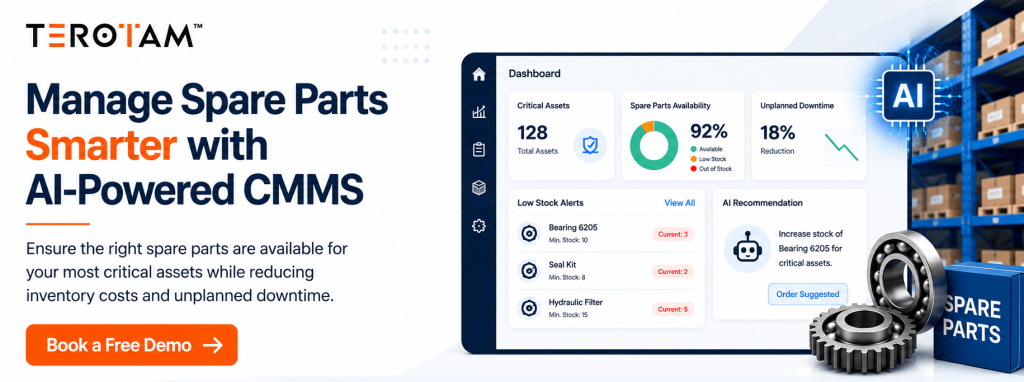
A modern Computerized Maintenance Management System (CMMS) enables organizations to link assets, maintenance history, inventory, and procurement into one integrated workflow.
A typical process looks like this:
Asset Criticality Assessment
↓
Maintenance History Analysis
↓
Failure Trend Identification
↓
Spare Parts Consumption Tracking
↓
Automatic Reorder Alerts
↓
Purchase Planning
↓
Reduced Downtime and Optimized Inventory
With TeroTAM CMMS, manufacturers can strengthen this process by:
- Mapping spare parts directly to assets.
- Tracking inventory availability across multiple locations.
- Monitoring spare parts consumption in real time.
- Recording complete maintenance history.
- Managing minimum and maximum inventory levels.
- Generating automatic reorder notifications.
- Integrating inventory with maintenance work orders.
- Analyzing inventory costs and equipment performance through dashboards.
Instead of relying on assumptions or manual spreadsheets, maintenance managers gain complete visibility into inventory requirements and can make informed purchasing decisions that improve operational efficiency.
Conclusion
Effective spare parts management is not about maintaining the largest inventory. It is about maintaining the right inventory for the right assets at the right time. By prioritizing spare parts based on asset criticality, manufacturers can reduce downtime, optimize inventory investments, improve maintenance planning, and increase overall equipment reliability.
A modern CMMS strengthens this strategy by connecting asset criticality, maintenance history, inventory data, and procurement into a unified system. With complete visibility into both assets and spare parts, organizations can make smarter inventory decisions that support long-term operational performance while keeping maintenance costs under control.
Looking to optimize your spare parts inventory without increasing costs?
TeroTAM CMMS helps manufacturers connect asset criticality, maintenance history, inventory levels, and procurement into one intelligent platform, enabling smarter spare parts planning and higher equipment reliability.
Contact contact@terotam.com to schedule a personalized demo.